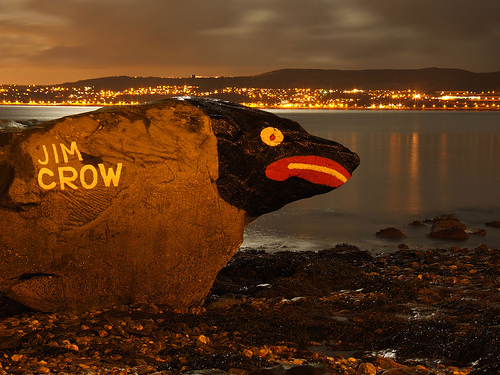
Photo by Scott Adams- http://www.flickr.com/photos/10021898@N02/797575782/in/photostream
On the shore a few hundred yards from where I live, is this rock.
It has probably been there since the last ice age, but at some point in the last 150 years someone thought that the point on one side looked like a beak so painted it black and began to call it ‘Jim Crow’. Quite who this was, and what the thinking behind the name was all about is unknown.
In June of this year there was much local controversy as someone painted over the decorations in the rock, restoring it to a natural stone colour. As far as we could tell, this seemed to be a protest against the symbolic meaning of a rock called ‘Jim Crow’. Here is the Dunoon Observers (somewhat partisan) take on the story at the time.
There was much debate as to what should be done about the rock- should it be repainted, or would it be better used as a different kind of community installation- perhaps decorated by different schools once a year…
However before this could be taken any further, someone had repainted the rock in its original colours.
So what is all the fuss about?
Well, the origins of the words ‘Jim Crow’ are pretty dreadful to most post modern sensibilities.
As far back as the middle of the 19th Century, ‘Jim Crow’ was a pejorative negative stereotype of people of African origin. ‘Jump Jim Crow‘ was a popular song and dance routine performed by white men with black faces in 1828 in the USA. The minstrel shows that began in this time became popular all over the world- and would certainly have spread to the music halls catering for day trippers ‘doon the watter’ towards the end of the Victorian era.
The words ‘Jim Crow’ were used as a description of black people at this time- in the same way that others would use ‘Nigger’ or ‘Sambo’.
But the infamy attached to the words was just beginning.
Following the widescale freeing of slaves following the American Civil war, the politics of the Southern states gradually returned to the Conservative whites, and from the 1870’s, a whole series of ‘segregation’ laws were enacted. These were known collectively simply as ‘the Jim Crow Laws’.
The effect of these laws on black Americans in the first half of the 20th Century has been well documented. It took the great struggles for freedom of the 60’s and 70’s to break their power.
There is a sample of the scope and extent of the laws here.
People fought and died over these issues, and for many the struggle against prejudice and narrow judgementalism continues.


So, back to our little rock in Dunoon.
I have heard it said that the name of the rock comes from the fact that there used to be a local joiners yard owned by Jim Crow opposite the rock. I doubt this myself, but in any case, the words ‘Jim Crow’ had too much resonance in the past to ever have been neutral or value free, and the decoration on the rock is just too black-and-white-minstrel.
As you can see from here , there are strong opinions locally. One argument goes something like this;
Jim Crow is a local landmark- which has been there for over 100 years, and has nothing to do with racism.
The only people who have a problem with it are ‘incomers’ who have no connection to Dunoon.
For many years we had an American Navy base here, with lots of black sailors. No one ever protested about the rock.
It is a harmless much loved piece of local tradition, and should be left just as it is.

Jim Crow on a photo dated 1905
But the sight of the rock, golliwogged up in garish new paint has always troubled me. I believe that where tradition and culture are in league with prejudice, then it is time to take a closer look at what we actually want to base our local tradition upon.
It’s symbolism may be obscure, but it is no less potent when set alongside recent American history.
I hear that the matter has been discussed in Scottish parliament, and there may yet be further scrutiny of the matter.
Get rid I say.











 this fragile tent