
thisfragiletent- 1000th post!

This is my 1000th post!

So I want to mark it in some way- beginning with a word of thanks for those of you who have visited and engaged with some of my meanderings. At present nearly 180000 of you.

Or perhaps one of you 180000 times.

I started this blog in June 2008- for reasons which are slightly lost to me now- something to do with reaching out, and also reaching in. It was a means to flex my writing muscles and a place to post photographs. It was my stab at significance in the full realisation that the internet was full of millions of voices doing the same. It very quickly became an addiction.

Or perhaps you could also say it has become a good habit (jostling with my many bad ones) as it has also provided me with a rather precious space- a Spiritual place, in which I deliberately seek to go beyond the surface of experience, into something that is deeper, richer, more meaningful. To me at any rate.

How much longer I will maintain the almost daily average post, I am not sure. I really need to put some time towards some other writing projects. But at present, it continues to be- important.

And whilst I know that there are so many potential draws on your attention in this age of mass communication, I am grateful that some of you still think it it worth visiting.

Michaela suggested that I should celebrate by listing some of the things that have inspired me. It seemed like a good idea- until I tried to make a list.

It would be a long list- and I would anguish over it. But how would I do justice to the breadth of inspiration that comes to me? How can I account for the chinks of God-light that I see in so many things?

So I will not make a list. Rather I will offer you a poem from one of my favourite poets- Edwin Morgan. He died last year, aged 90, but when he hit 80 years old, he wrote this poem. May it capture something of our future my friends, as we head out again into the unknown ocean…

At Eighty

Push the boat out, compañeros,
push the boat out, whatever the sea.
Who says we cannot guide ourselves
through the boiling reefs, black as they are,
the enemy of us all makes sure of it!
Mariners, keep good watch always
for that last passage of blue water
we have heard of and long to reach
(no matter if we cannot, no matter!)
in our eighty-year-old timbers
leaky and patched as they are but sweet
well seasoned with the scent of woods
long perished, serviceable still
in unarrested pungency
of salt and blistering sunlight. Out,
push it all out into the unknown!
Unknown is best, it beckons best,
like distant ships in mist, or bells
clanging ruthless from stormy buoys.

Edwin Morgan

Aoradh meditations- Psalm 148, Tuesday…

Delayed this time by a power cut! The storm last night has blown trees down on the power lines, leaving Bute and Cowal without power for half of today. A little reminder of how vulnerable we are to a little weather.

At work- no computers, no phones, no mobile telephones (masts down too.) If you are vulnerable, no stair lifts, no e-care, no anti-pressure beds, no hot food, no heating. Scary really, just how dependent we are on something so artificial. Well done Dave and the boys for getting it back on in record time…

But back to the matter in hand- Psalm 148, the wonder of it all…

Look carefully at this picture. At first all black- but when you look again…

5 Let them praise the name of the LORD, 
for at his command they were created,
6 and he established them for ever and ever— 
he issued a decree that will never pass away.


Light waves falling

.

Some blazing hot

The noon we circle round

Some a warm reflection

Smiling in the night sky

Some a tender starlight flicker

Almost unnoticed

.

All of it made-

Not manufactured

Crafted-

Not mass produced

.

Fractals of the infinite

Particles of the Divine

Making a prism of my soul

Aoradh meditations, Monday, Psalm 148…

This week it is my turn to write a daily meditation for Aoradh. I will post them here too.

This time I will write around the exuberant praise of Psalm 148. A challenge for introspective types like me…

Psalm 148

Praise the LORD from the heavens;
praise him in the heights above.
2 Praise him, all his angels;
praise him, all his heavenly hosts.
3 Praise him, sun and moon;
praise him, all you shining stars.
4 Praise him, you highest heavens
and you waters above the skies.

Stand with the Angels

At the roof of the world

And shout with joy

At the wonder of it all

For the space that goes for ever

And we,  just shapes

Suspended

The one that got me…

I live in a beautiful place. Check out the lovely Visit Cowal site here if you do not believe me.

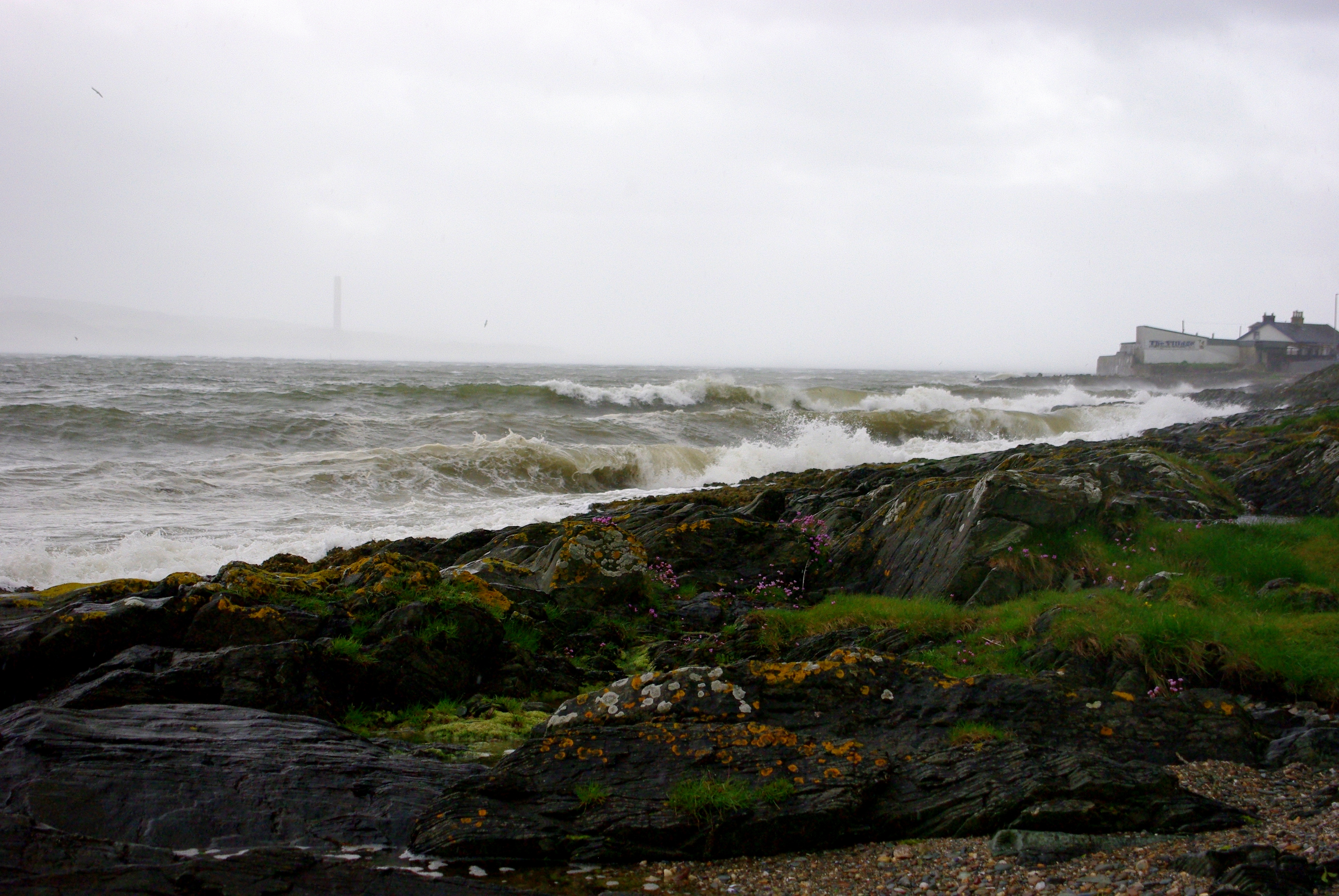
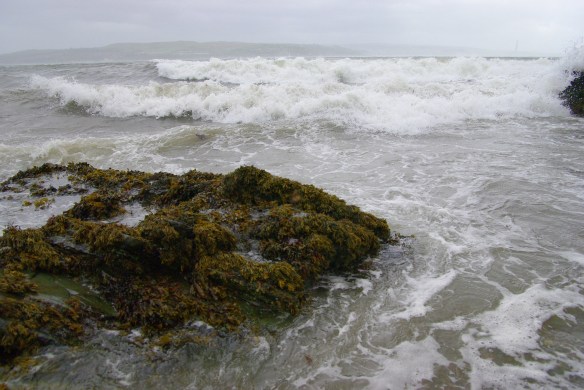
It is something I often take for granted (for which I ask forgiveness) but at other times, it hits me between the eyes. Today there is a storm raging in from the Atlantic, and the sea is being whipped into froth and spray- despite our relatively sheltered location.

The exuberant power of it is exhilarating, but also a little frightening.

Of course, the camera comes out at times like this.

Except this time, I wandered a little close to the surf, and suddenly found myself wet above the knees.

Oh deary me, I said.

This was the one that got me-

Bible nasties 6- that thing called hell…

Returning to the series I began in April (If you want to read the others, you can also use the ‘search’ box on the right) trying to chew on all those difficult passages in the Bible. When you start doing this, you are confronted with some fundamental questions- about the nature of doctrine, the authorship of the Bible and the very stuff of belief itself.

Hmmm- perhaps I should not have started this.

It also brings you up against the apparent violence and wrath of God- ultimately stretched out in potential eternal torment in hell.

I liked what Francis Chan has to say here- (HT Robin Parry.)

Chan’s book looks like it is worth a read…

Navigation…

A few photos from the last week.

More rain here- missed another cricket match- due to be played at the wonderful Mount Stewart house on Bute. Whoever thought that cricket could be played in a West of Scotland climate?

A climate dominated of course, by the sea.

This ship sailed past our house the other day- like a ghost of memory. It is a training ship, the Stavros- which Emily is hoping to get a chance to sail on next year.

Forward a little, from the age of the square rigger to the age of the steam puffer- the ubiquitous water lorry of the Inner Hebrides until around the middle of the last century. Another ghost, seen here passing through the Kyles of Bute-

The sea has been cruel this week too. The storms roll in from the Atlantic. Who would be a sailor?

Apart from Emily that is…

What do you do if you predict the second coming- but get it wrong?

It’s all a bit an anti climax.

No rapture after all.

Might have been nice to rise with a trump and fly…

But what do you do if you are a preacher, famous the world over for your predictions- made with resounding certainty- and you are proved, well- resoundingly wrong?

Perhaps you just pick a different date- certainly, that is what Harold Camping did last time- in September 2004.

What amazes me is the degree to which people who are caught up in the madness of all this seem to keep faith with men like Camping- whose credibility seems to be able to survive such obvious false prophetic utterances. All that ‘infallible word from God‘ nonsense. They used to stone prophets that were proved false in the old days…

Not that Camping is unique- I have written before about my own memories of this kind of stuff from childhood- when Chuck Smith was making his predictions. It did not seem to do him any harm either. There is a list of other predictors in this post.

A quick review of the Christian response (as opposed to others who must just think we are all bonkers) reveals that people fall into two main camps-

The superior dispensationalist camp

There was that recent survey result that suggested that over 5o% of Americans believe that the faithful will be taken up to heaven in a Rapture event, so you can bet that this camp is pretty large. Sixty million of them have read the ‘Left Behind’ Tim la Haye books after all.

We can not predict the time of these events, they would say- Jesus said that you would not know the ‘day nor the hour’ of his return (but I knew a man who claimed to know the month and the week!) So predictions are futile- whereas a general prediction about us being in the ‘end times’ and a rapture being likely within our lifetime- this is more ‘mainstream’ a prediction.

Or they might say more ‘Biblical’ a prediction…

The ‘Book of Revelations as allegory’ camp…

This group understand the writings of the Book of Revelation in a very different way. Rather than seeing it all as a description of wild future events, they would suggest that it was a coded attack on the times and context of the writer- the 1st/2nd C Roman Empire. These people hoped and believed that Jesus was about to return.

They would suggest that those who read now should seek to apply the critique of this powerful but bizarre imagery to our own society- but not as a means of opting out, rather as a means to hope for the Kingdom of God to be revealed here and now.

NT Wright talks about this here. He differentiates between the Apocalyptic language- using cosmic language to invest historical events with their full significance, and; “apocalypticism” which is a means by which people use these ideas to conjure up dire predictions about the end of it all.

Apocolypticism is a way for us to split everything into two again- the in and the out. The good and the bad. The heavenly and the earthly. Or as NT Wright puts it-

“Apocalyptic language exploits the heaven/earth duality in order to draw attention to the heavenly significance of earthly events; apocalypticism exploits apocalyptic language to express a non-biblical dualism in which the heavenly world is good and the earthly bad.”

I will leave you to guess which camp I belong to!

What is left to ask about all this end times stuff is this- ‘What does it say about western society (or American society at least) that men like Camping can still hold such influence?’

Might it mean that (as NT Wright puts it) the dreams cherished by our culture for 200 years or more have let us down?  Capitalism gave us rampant consumerism and boom and bust. Science gave us global warming and nuclear weapons. Democracy gave us stable power hierarchies (we used to call it ‘class’) that are remarkably resilient and difficult to change.

Faced with this crisis in our ability to hope and believe for the future, we people of faith have a choice- along the lines of the camps above.

We can proclaim the end of it all, and offer only the hope of a few of us being sucked away from the stinking rotten corpse that is this world, or we can become hopeful critical collaborators in our culture- salting those things that have good flavour, and shining light where there is darkness that requires illumination.

Breaking the frame…

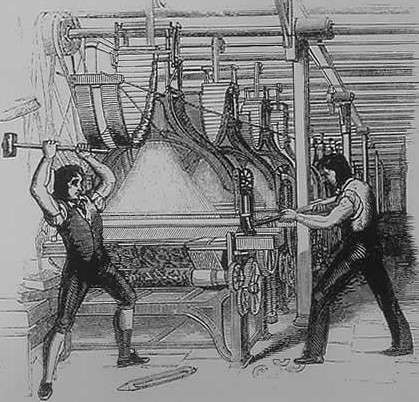
Great programme on radio 4 today- The Luddite Lament

In The Luddite Lament, the award winning folk singer John Tams looks back at the machine breakers of the 19th century, through the prism of the songs they inspired.

Two hundred years ago parts of Britain were on the brink of rebellion – and you could be imprisoned for singing a song. There were said to be more troops on the border of Yorkshire and Lancashire than on the Continent with Wellington. The reason? Men armed with hammers, pikes and even guns were attacking mills in protest at the introduction of new machinery. Luddism began in the Midlands in 1811 and swept northwards to Yorkshire and then Lancashire.

In many ways this is the historical context that I emerged from- northern industrial Albion. I was born in Nottinghamshire, amongst the old mill and mining towns, before moving to live in Lancashire- on Fox Lane, front line of the old technological industrial transformation. The Step Houses opposite from my old house were built as weavers cottages, purchased by families through perhaps the worlds first Mutual Friendly Society. They flourished, until the coming of the machines that could replace all that artistry and skill with a powered weaving frames.

There is a rumour that my old local pub was used as a courthouse and prison to house some of the rioters before their transportation to Australia.

The Luddites are a footnote in history, most remembered as a name used as a term of abuse. This tends to be the fate of failed revolutionaries, particularly working class ones. They tried to break the frames that others would place around them- but this was a battle that the mill owners and the power mongers could never afford to let them win.

Perhaps the only part of the stories of these people who fought to preserve their way of life that has been preserved are the handful of songs– mentioned in the programme above.

The machines that swept aside the Luddites ushered in global industrial capitalism, but by the time I was growing up, the machines had moved on. A new surge of greed resulted in the destruction of more communities- history was being reframed as Thatcherism swept the north of all its heavy industry. We had our own Luddites, in the form of the National Union of Mineworkers. They too tried to weild Enoch’s hammer but they could not break the frame either. It broke them.

We do well to remember our history, and our songs- particularly when they tell the stories of the powerless and disenfranchised, at times when the weight of industrial-military power is used to aid the greed of the few.

General Ludd's Triumph. 
.
No more chant your old rhymes about bold Robin Hood
His feats I do little admire.
I'll sing the achievements of General Ludd,
Now the hero of Nottinghamshire.
Brave Ludd was to measures of violence unused
Till his sufferings became so severe,
That at last to defend his own interests he roused,
And for the great fight did prepare. 

The guilty may fear but no vengeance he aims
At the honest man's life or estate;
His wrath is entirely confined to wide frames
And to those that old prices abate.
Those engines of mischief were sentenced to die
By unanimous vote of the trade,
And Ludd who can all opposition defy
Was the grand executioner made.

And when in the work he destruction employs,
Himself to no method confines;
By fire and by water he gets them destroyed,
For the elements aid his designs.
Whether guarded by soldiers along the highway,
Or closely secured in a room,
He shivers them up by night and by day
and nothing can soften their doom.

He may censure great Ludd's disrespect for the laws,
Who ne'er for a moment reflects
That foul imposition alone was the cause
Which produced these unhappy efrects.
Let the haughty the humble no longer oppress,
Then shall Ludd sheathe his conquering sword;
His grievances instantly meet with redress,
Then peace shall be quickly restored.

Let the wise and the great lend their aid and advice
Nor e'er their assistance withdraw,
Till full-fashioned work at the old-fashioned price
Is established by custom and law.
Then the trade when this arduous contest is o'er
Shall raise in full splendour its head;
And colting and cutting and squaring no more
Shall deprive honest workmen of bread.

This one was probably written in (or at least about) the town of Sutton in Ashfield, where I was born-

Ye kind-hearted souls, pray attend to our song,

And hear this true story which shall not be long;

Framework knitters of Sutton, how ill they are used,

And by the bag-masters how sorely abused.

Chorus

Derry down, down, down derry down
They’ve bated the wages so low for our work

That to gain half maintainence we slave like a Turk;

When we ask for our money comes paper and string,

Dear beef and bad mutton or some suchlike thing.

Chorus
Bad weights and bad measures are frequently used–

Oppressive extortion–thus sorely abused;

Insulted and robbed, too–we mention no names–

But pluck up our spirits and bowl in their frames.

Chorus
Good people, oh pity our terrible case,

Pray take no offence though we visit this place;

We crave your assistance and pray for our foes,

Oh may they find mercy when this life we lose.

Chorus

Interviews with Jesus…

I liked this series of ‘interviews’ with Jesus– a simple and rather old fashioned didactic vehicle, but very well written- direct and controversial whilst full of love and fun- rather like the man himself. Thanks to Chris Howson for pointing them out.

They are recorded in Spanish, but the English transcripts are available.

The producers of these narratives are a brother and sister- María and José Ignacio López Vigil, based in Ecuador and Nicaragua, and clearly come from a perspective influenced strongly by Liberation Theology, and engagement with justice issues in South America.

I am thinking of trying to use some of them here…

Here is one typically challenging example.

RACHEL The microphones of Emisoras Latinas are still here on the Mount of the Beatitudes. Before us we have a panoramic view of the Sea of Galilee, and with us again, in an exclusive interview, is Jesus Christ. In an earlier segment, Jesus, you referred to the second part of the historic discourse you gave on this mountain. What did you speak of in that second part?

JESUS Well, first of all I blessed the poor people and congratulated them.

RACHEL And after that?

JESUS After that I cursed the rich people.

RACHEL You… cursed?

JESUS Yes, I cursed the rich people.

RACHEL Can you repeat your words for us?

JESUS I said it then, and I say it now Woe to you who are rich, who are well-fed, because you will go hungry. Woe to you who laugh and make fun of the poor, because very soon you will weep and cry out when God empties your coffers, when God rips off your clothes and your jewelry and leaves you without bread and without money to buy anything, just as you did with your workers!

RACHEL Those are very hard words.

JESUS Much harder is the heart of stone of people who don’t want to share.

RACHEL Perhaps there are people listening to us now who are wealthy but also generous – people of humble spirit. Would you curse them also?

JESUS Once a rich young man with a good heart wanted to join our band. He wanted to put his hand on the plow of God’s Kingdom.

RACHEL And what did you tell him?

JESUS You have to choose either God or money. If you want to join us, first share out your wealth among the poor.

RACHEL If those were the conditions… I don’t think many rich people would have taken part in your movement.

JESUS A few understood, but the truth is that in those days, as in these, it’s easier for a camel to pass through the eye of a needle than for a rich man to enter the Kingdom of God.

RACHEL Your message doesn’t sound politically correct. Don’t you feel it’s too radical?

JESUS Radical, yes. We took the axe to the root, because the root was rotten.

RACHEL They have always taught me that you were meek and humble of heart, but now I find you a little … how to say it? … a little intolerant.

JESUS God does not tolerate injustice, Rachel. In the end God will not ask us about rites or prayers, God won’t ask us about fasting and temples. We will be examined only regarding our justice, and God will be relentless with those who are unjust.

RACHEL You’re quite stirred up …

JESUS Didn’t you ask me to recall what I said on this mountain?

RACHEL Even so, could we close off our program by restating that your message is really a message of peace?

JESUS God’s message is fire upon the earth, and I can’t wait till it’s blazing! Listen, Rachel, if every morning of your life you don’t earnestly desire for there to be an end to wars, violence, lies, envy, power-mongering, then you’ll never understand my message.

RACHEL Is there anything else you’d like to add?

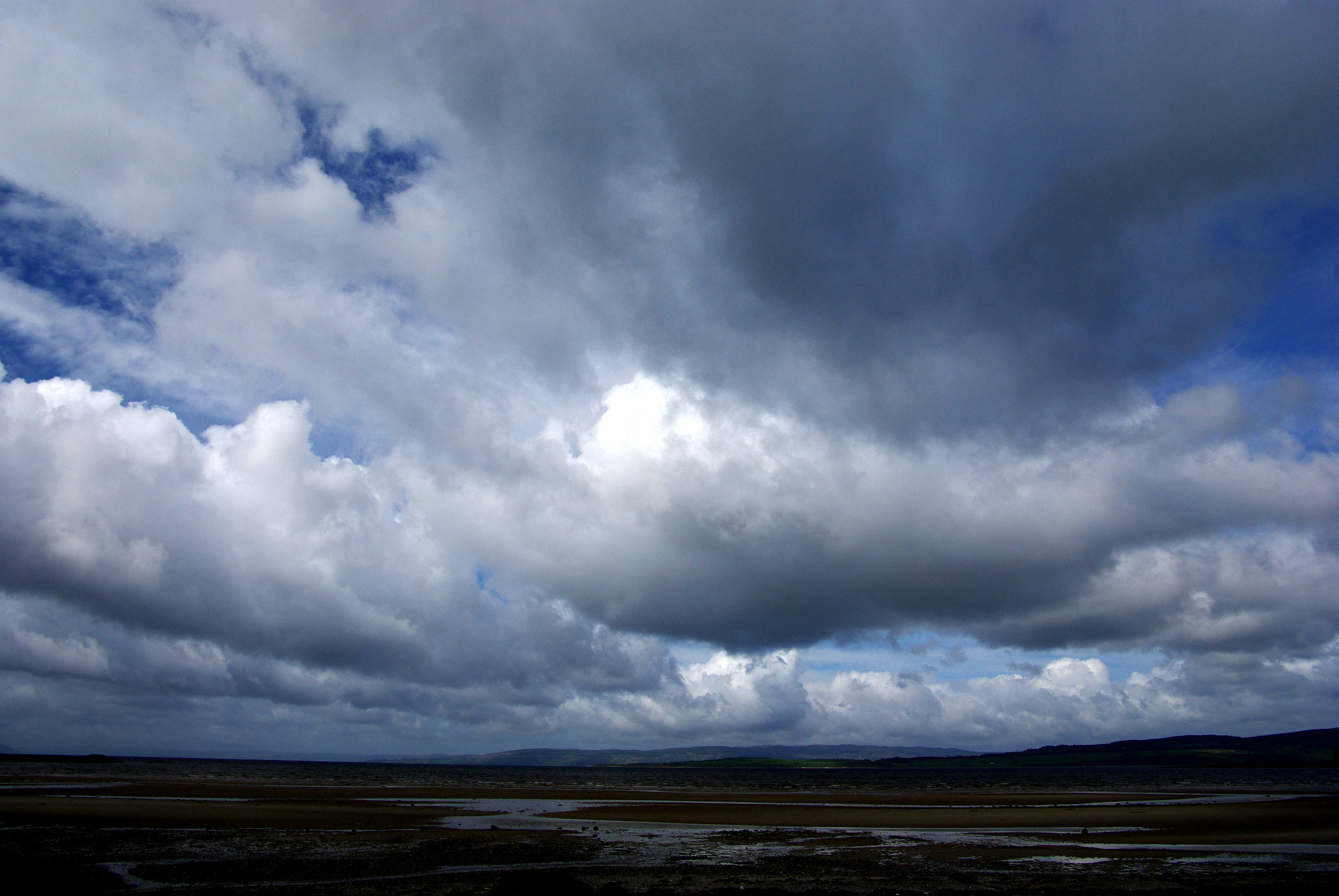
JESUS Look toward the horizon, Rachel. In these very days in which you’re living, I see signs in the heaven that announce a storm coming. Let those who have eyes to see observe the signs, and let those who have ears to hear listen to what’s going on.

RACHEL We are talking with Jesus Christ in his second coming to our modern world, which is ever more unequal – and therefore ever more violent. The Mount of the Beatitudes, Rachel Perez, Emisoras Latinas.

MUSIC

ANNOUNCER Another God is Possible. Exclusive interviews with Jesus Christ in his second coming to Earth. A production of María and José Ignacio López Vigil, with the support of the Syd Forum and Christian Aid.