Some days you just need to listen to some Gospel music…

… and when those days come, reach for something – anything – by Mahalia Jackson.

This extraordinary woman chose to sing Gospel all her life- she could have sung whatever she wanted, with her incredible powerful voice. She would stand there, dressed like someones grandmother complete with church-hat, and then let rip. It was a force of nature that could break hard men somewhere inside. When asked why she sang Gospel she said this;

I sing God’s music because it makes me feel free,” Jackson once said about her choice of gospel, adding, “It gives me hope. With the blues when you finish, you still have the blues.

She sang before Martin Luther King gave THAT speech (and at his funeral) and her voice has power and authority even now that successive musicians have tried to borrow from- and mostly failed.

Today I need some Gospel music. Thanks Mahalia.


The relationship between materialism, happiness and Christmas…

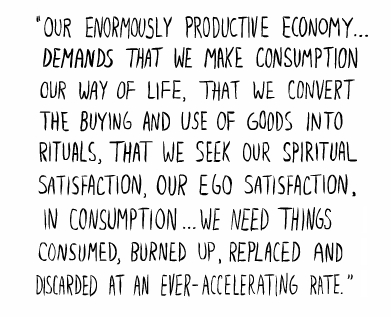
consumerism

There are some things that all the worlds religions kind of agree on- almost as if in the distillation of spiritual wisdom of the the millennia, certain concepts were inescapable. One of these is our attitude towards possessions. Quite simply, they are more often than not regarded as an obstacle to enlightenment, not a path towards it.

Perhaps the most hard core religious response to the accumulation of wealth and possessions was Jesus- we all know the biblical passages and the perenthetical BUT we have added on to each and every one of them. It remains one of the great human paradoxes as to how Consumer Capitalism has been able to grow in a western culture dominated by Christianity- not just in spite of our faith, but almost because of the way we live it out. We have come to believe that Jesus is at heart a white middle class respectable home owner.

visa cross

There was a brilliant article by George Monbiot in The Guardian yesterday that opened all this up again for me. He took a long look at consumerism, sharing some research about the impact of materialism on well being, sociability and mental health. He pulls no punches; Worldly ambition, material aspiration, perpetual growth: these are a formula for mass unhappiness.

Monbiot quotes a lot of research into the impact of materialism- here are a few examples;

There has long been a correlation observed between materialism, a lack of empathy and engagement with others, and unhappiness. But research conducted over the past few years seems to show causation. For example, aseries of studies published in the journal Motivation and Emotion in July showed that as people become more materialistic, their wellbeing (good relationships, autonomy, sense of purpose and the rest) diminishes. As they become less materialistic, it rises.

In one study, the researchers tested a group of 18-year-olds, then re-tested them 12 years later. They were asked to rank the importance of different goals – jobs, money and status on one side, and self-acceptance, fellow feeling and belonging on the other. They were then given a standard diagnostic test to identify mental health problems. At the ages of both 18 and 30, materialistic people were more susceptible to disorders. But if in that period they became less materialistic, they became happier.

In another study, the psychologists followed Icelanders weathering their country’s economic collapse. Some people became more focused on materialism, in the hope of regaining lost ground. Others responded by becoming less interested in money and turning their attention to family and community life. The first group reported lower levels of wellbeing, the second group higher levels.

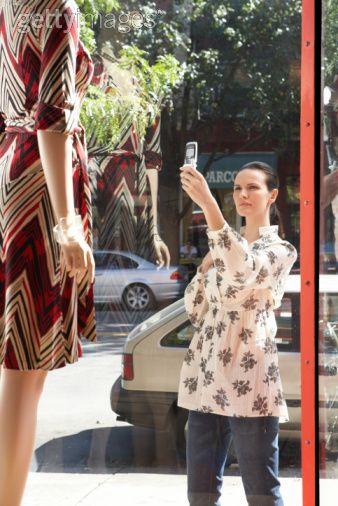
shop window

These studies, while suggestive, demonstrate only correlation. But the researchers then put a group of adolescents through a church programme designed to steer children away from spending and towards sharing and saving. The self-esteem of materialistic children on the programme rose significantly, while that of materialistic children in the control group fell. Those who had little interest in materialism before the programme experienced no change in self-esteem.

Another paper, published in Psychological Science, found that people in a controlled experiment who were repeatedly exposed to images of luxury goods, to messages that cast them as consumers rather than citizens and to words associated with materialism (such as buy, status, asset and expensive), experienced immediate but temporary increases in material aspirations, anxiety and depression. They also became more competitive and more selfish, had a reduced sense of social responsibility and were less inclined to join in demanding social activities. The researchers point out that, as we are repeatedly bombarded with such images through advertisements, and constantly described by the media as consumers, these temporary effects could be triggered more or less continuously.

third paper, published (paradoxically) in the Journal of Consumer Research, studied 2,500 people for six years. It found a two-way relationship between materialism and loneliness: materialism fosters social isolation; isolation fosters materialism. People who are cut off from others attach themselves to possessions. This attachment in turn crowds out social relationships.

As we read these studies, we instinctively know them to be true; there are no surprises here. Perhaps this is because of some kind of spiritual residue left in our psyches from all those religious people who made these discoveries previously. Perhaps also each generation has to learn it anew.

However, we in the West are more than pilgrims who have wandered off into some consumer-bog, we have become hostages.

consumerism

A few years ago I read Pete Ward’s excellent book ‘Liquid Church’, in which he suggested that  ‘rather than condemn the shopper as materialist Liquid Church would take shopping seriously as a spiritual exercise.’ What Ward was seeking to do was to get the church to engage fully with the culture we are part of- to flow in its veins. I found this idea very helpful at the time- it enabled me to move from a fixed blinkered position which saw culture dominated by consumerism as universally bad (despite my full participation within it) towards a deliberate attempt to read culture through its patterns of acquisition. So if you look hard at lots of the advertisements we are bombarded with you will start to see the yearning behind the selling. What the advertisers are trying to do is to connect us with something beyond the physical aspect of the object, into the meaning it brings into our lives- so a car is not a good piece of engineering, it is a symbol of freedom, of self expression, of celebration of our lives.

Having understood this however; having looked again at our culture through its predominant consumer characteristics, where does this take us? I am more and more convinced that it takes us towards one thing only- the need to become engaged critics. Enraged critics even.

Let us turn over some tables in the temple.

Which brings us to Christmas again.

I know, I know, the calls to make Christmas less consumer-driven are getting a bit old. I have been banging on about it on this blog for years. Lighten up a little! Have some fun! There is nothing wrong with spending a bit more at Christmas after all.

Except, as our religious forefathers knew, and as Monbiot has underlined, let us not kid ourselves that any of this is making us happier. Let us not suggest that buying lots of stuff (even for others) is making us more sociable, more loving, more empathetic, more caring.

Rich and poor alike are caught up in this addictive destructive cycle. What would it mean to be clean?

What would it mean to be free?

A little lower than the Angels…

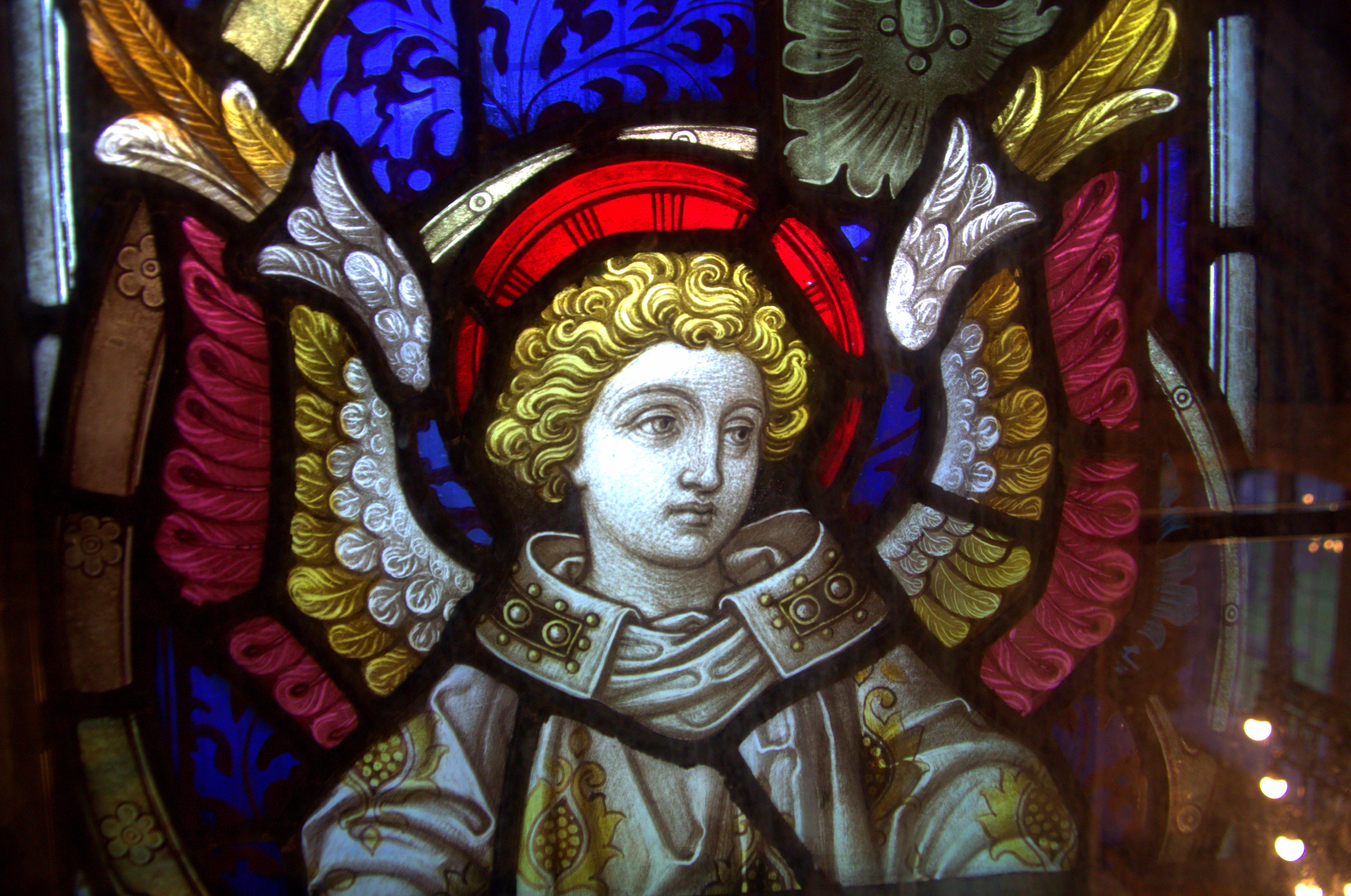
angel


Psalm 8:5-9

from The Message

5-8 Yet we’ve so narrowly missed being gods,
bright with Eden’s dawn light.
You put us in charge of your handcrafted world,
repeated to us your Genesis-charge,
Made us lords of sheep and cattle,
even animals out in the wild,
Birds flying and fish swimming,
whales singing in the ocean deeps.

9 God, brilliant Lord,
your name echoes around the world.

_IGP3958

Dear Dunoon Observer…

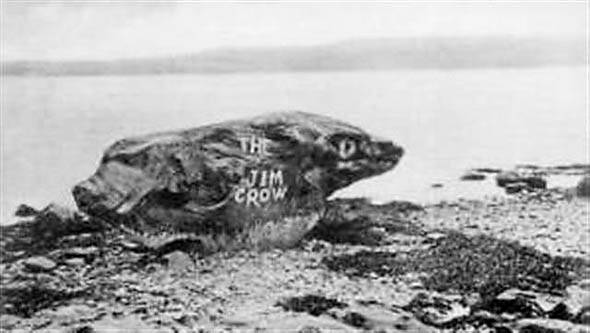
jimcrow03


Following on from yesterdays post, I sent a letter to our local paper. This is not something I make a habit of- in fact this will only be the second such letter I have sent. The previous one was not published- and was triggered by the same issue.

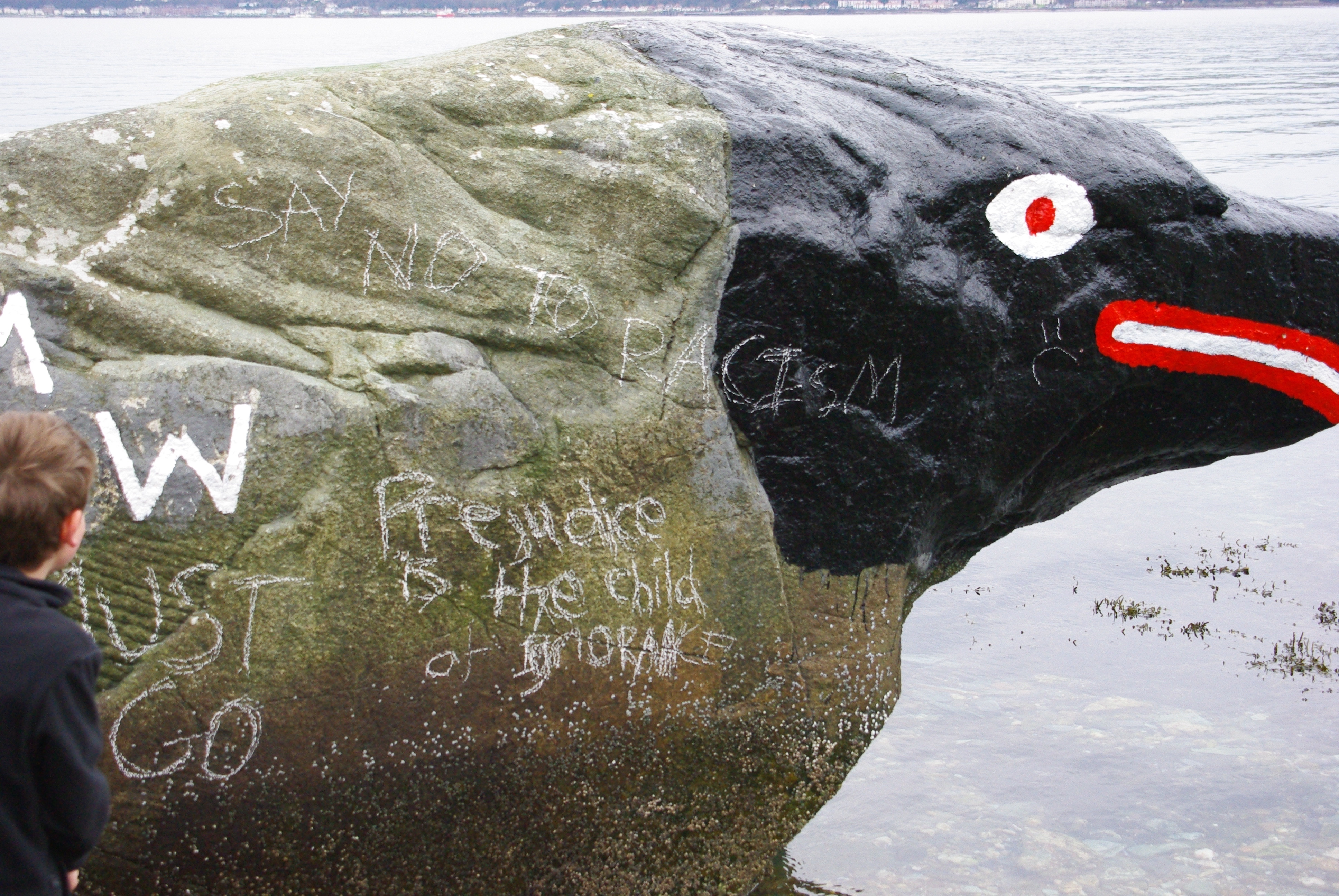
At that point I took exception to a rather poorly researched story in the paper after the rock’s Golliwog face has been painted over by a protester. (NO- it was not me, although some of me wishes it was.) It made no reference whatsoever to the Blackface tradition, nor to the objections raised to the decoration on the rock by others, not least the Racial Equality Unit.

Today I sent this to the editor. I am expecting a backlash- lots of people will be very angry. However, I walk past this stone several times a day, and each time it makes slightly ashamed.

Letter for Dunoon Observer

6.12.13


Dear Editor

The death of Nelson Mandela seems like a very good time to take another look at some of our own racist history. In doing so we very soon have to concede that the prosperity of this area owes much to international trade; shipping, sugar, tobacco and slavery. It is to the credit of Britain that as well as participating in slave trading we did much to end this practice at the beginning of the 19th Century. However, many would argue that we replaced slavery with Colonialism.

Alongside this, our attitudes towards the non-white people of the world has often been to view them as less-than. We supported this with entrenched prejudice and even with the so called ‘science’ of eugenics. These ideas found expression in our politics (segregation, apartheid) and also in our popular culture.

One of the most pervasive cultural carriers of this prejudice were the ‘Blackface’ caricatures that developed the world over- the Golliwogs, the Minstrel shows, Zvarte Piet and Jim Crow. Understanding how these have been a channel for racism is not easy, but they are commonly understood to allow culture to reduce the feared outsider to a figure of derision. A feckless, chicken loving, sexualised layabout who steals washing from the line, but is good at singing and dancing.

Which brings us to our own Jim Crow Rock, Only in Argyll does anyone seriously suggest that this has no racist origins. The Jim Crow museum in the USA expressed horror, the Racial Equality Unit is clear about its ‘Blackface’ beginnings, outsiders stand and look puzzled. When confronted with these outside perspectives, our response has often been to become angry and defensive, refusing to engage in any real discussion about the origins of the rock.

So, here is a suggestion; as a memorial to the late great Nelson Mandela, why do we not invest in an information board on the foreshore next to the rock? It could say some of these things;

It could acknowledge the local controversy, and disagreements about the origins of the decoration. It could deal with the role of the Clyde in the slave trade. It could talk about Blackface caricatures and the minstrel shows that were performed here in Dunoon’s heyday. It could talk about the Jim Crow Laws in America, and how they enforced segregation, prejudice and apartheid.

Above all, it could transform a local curiosity from something that is at best controversial (if not downright offensive) into something that we can all feel pride in the ownership of once more.

Yours sincerely


Chris Goan

Hunters Quay

jim crow prejudice

Despite Mandela-adulation, racism persists…

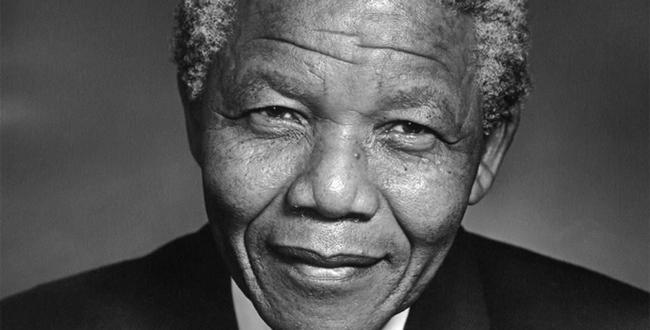
Nelson Mandela

The great man is dead, and world leaders are tripping over themselves to cosy up to his memory. In the process, he becomes like some kind of neutral mirror in front of which others preen themselves.

He is a freedom fighter, a champion of western capitalist democracy. (Forgetting that he was also a communist revolutionary.)

He is the man of peace who chose the path of non resistance. (Forgetting that despite all the pressure to do so, he never renounced the need for an armed struggle against the state.

He is the icon of international statesmanship by which all others are measured. (Forgetting that a few short years ago many regarded him as a terrorist- including much of the Conservative government under Thatcher.)

He was the civilised face of Africa, the educated black man. (Contrast this with the way that our newspapers talk about all other black politicians in South Africa since.)

None of this should diminish the man, but it might be regarded as creating a degree of confusion, particularly as we consider the degree to which the racism that kept Mandela locked away in prison for so many years has really changed. Did his release and subsequent elevation to international sainthood mean that the battle was won?

We live in a world in which racism, of both the direct and indirect kinds, is alive and well. We still live in fear of the outsiders, who will take our jobs, ruin our NHS, steal our homes and drain our resources. When these outsiders are black or Asian, this seems to add a higher degree of concern. Australians have almost banned non-white immigration. Unfair trade relationships ensure that the white West will continue their economic ascendancy at the direct cost of the poor south- who send us their minerals and produce our goods for us. The abolition of most formal apartheid systems (African, American) has done little to change the distribution of wealth and power between black on white people, both within societies and across nations. Beware those characterisations of passive-Mandela that allow us to forget this- it does the memory of the great man no favours.

We the privileged have a reciprocal responsibility to act out the gift of it with grace. Part of this might be to confront the injustices that we inherit- both to understand the cost of this privilege, but also to confront our propensity towards self justification. This seems all the more important as the people in power line up to put a slice of Mandela in their top pockets.

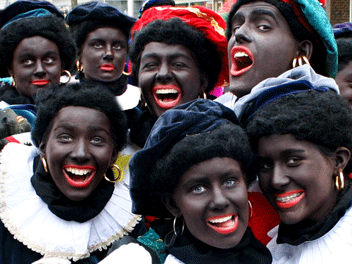
In the spirit of ‘minding our privilege’ (a rather useful American phrase) I was reminded today of two other stories that carry more than a little of the old racist divisions. The first one is this one, concerning the tradition of Zwarte Piet or ‘Black Pete’ in Dutch traditional Christmas celebrations.

black-pete-netherlands

As the Netherlands gears up for its annual Saint Nicholas celebration on Friday, the festivities are in danger of being overshadowed by a growing row over his helper and clown, “Black Pete”.

While families exchange presents and eat cakes to welcome Santa Claus’s slimmer and more sober ancestor, criticism of the crude depictions of his sidekick, known locally as Zwarte Piet, has reached the United Nations.

The clown is usually portrayed by a white person in blackface, who goes around offering sweets to good children and, according to legend, threatens to collect naughty ones in a sack to be taken to Zwarte Piet’s home in Spain. But he is increasingly reviled by critics as a racist relic of Christmases past.

Momentum has been growing against the custom, in part thanks to campaigners such as Quinsy Gario, a poet and activist born in the former Dutch colony of Curaçao who was arrested two years ago for wearing a T-shirt with the slogan “Black Pete is racism” at a Saint Nicholas parade in the city of Dordrecht. Gario’s message is that the tradition perpetuates crude stereotypes.

From The Guardian.

The criticisms of Zwarte Piet have stung the Dutch, 91% of whom seem to want to keep it as part of their tradition, and will say it is harmless, and the black face is just because Piet comes down chimneys. However, the roots of the tradition seem to go back to ideas of good (St Nicholas) overcoming evil, and chaining the devil to service. The Devil of course, is African. He is less-than-human, a worthy recipient of our projected fears, hidden behind all the grease paint and derision.

Zwarte Piet reminds me very much of another blackface image that is a lot closer to home- about 100 meters in fact, the controversial Jim Crow rock;

Western ferries passing jim crow

The blackface/Golliwog imagery of Jim Crow and Zvarte Piet are a direct link with the racism that justified slavery, that built the wealth of the West, that created colonialism, that gave birth to apartheid,  and that Nelson Mandela gave his life to confront head on.

Perhaps a fitting memorial for his death might be to take another look at this history, and to mind our privilege.

Dunoon folk- I have said this before, and I respectfully say it again;

“… there can be no doubt that the painting of the ‘face’, with its exaggerated red mouth, is a typically caricatured image of a black person, as popularised by the American entertainer T.D. Rice in the nineteenth century. […] I feel certain that black visitorsfrom outside would see this as somewhat insulting […] as a derogatory reference to their skin colour and origins.”

Institute of Race Relations.

So –  are we sure that this is just a little bit of harmless local colour? And even if it is just that- are we really comfortable with the associations that are being made, and the offence that this might carry to the descendants of slaves who had to fight on for generations against the oppression of the Jim Crow laws?

If the rock is to stay, then we need to tell these stories.

If we are to keep the face on the rock- then let us also put a big sign on the foreshore dealing with the darker side of our past…

Do you love your country?

This was the question asked of Guardian Editor Alan Rusbridger by MP Keith Vaz whilst he was being quizzed about the papers exposure of what western security forces were doing in our name to spy on ordinary people.

The story of how a former NSA contractor Edward Snowden has exposed the shady practices of our security services is a rather fascinating one, but I find myself lingering on this question- “Do you love your country?” 

It seems such an un-British question. Love of country seems to be a prerequisite for anyone involved in public life in the US, but not here. We are usually slightly embarrassed by such displays of public patriotism- such things belong to an age of imperialism, or perhaps to the extremism of the English Defense League.

I have not even heard friends who are fervent supporters of Scottish independence say that they love their country- not through lack of passion and commitment I am sure, but rather because most of us are simply not sure what such a phrase might mean.

Does it mean blind unswerving partiality and loyalty to everything that our country contains- north or south of the border? Does it mean being prepared to die to ensure that our ascendancy is continued or enhanced?

Does it mean a love of place- the shape of the land and the history contained in each and every stone?

Does it mean a love of SOME parts of what might be contained within ‘country’, and even a loathing of others?

I have written some musings about how we might describe a ‘good’ country before, and said this;

I am British- somewhere inside. I find this difficult to define- as an English/Irishman living in Scotland. I am grateful for the gentle green climate of these beautiful islands, and for the slow pragmatic evolution of our welfare state.

But (in the words of many a school report) we could be doing better…

Does this mean that I love my country? I think the word love is meaningless when applied to something to huge, so complex. I love my wife, I love my kids, I love vinegar on my chips and cricket bats and Bruce Cockburn’s music. But my country?

I think the job of my country is to provide the graceful just framework for us to learn to love each other better. As soon as we start with the flag-worship nonsense too much gets hidden in the shadows.

Well done The Guardian for making this clearer.


The poet in the pub, under the helicopter…

clutha

The news has been full of the terrible story of the police helicopter that crashed into the Clutha pub in Glasgow at the weekend. 9 people dead so far, as they still try to clear away the unstable remains of the old meeting place.

The pilot of the helicopter visited my kids school not so long ago…

One of the dead was a poet, John McGarrigle, who wrote of life in Glasgow with an honest voice- speaking of unemployment, drugs, human warmth and emotion in witty and funny ways. There seem to be a sad few of his poems on line, but there are a couple here. I did not know his work well, although had heard of him.

What a way to go. Sitting with your friends in your regular seat in a the local, sharing stories like poetry…

I thought I would write my own tribute to John, by way of deep respect to those who have lost loved ones in Glasgow. Here is the first draft;

The death of John McGarrigle


John holds court in the Clutha

Spinning yarns like fag smoke

Filling the fug with the chug of laughter

Tapped, not canned

The drink at his lips was welcome

But not strictly necessary

Sentence cut short

By a tumbling helicopter


They say it came through the roof

Right above Johns seat

Where others deferred

To the Clutha poet


How should a poet meet his end

On some blasted heath?

Should they wear away like old parquet

Or a set of ill-fitting false teeth?


John had a poem in the curl of his glass

When the chopper fell down on his head

Emily’s birthday ceilidh pics…

It is nearly 10 AM on the morning after. 4 people are up in the house- out of (I think) 35. I had around 4 hours sleep, but these days wake when the day calls me rather than listening to what it needs. Just thought I would post a few photos from last night for those of you who were not able to join us to dance Emily into adulthood!

It was a a great night- we had a piper, a great band (Canned Haggis, who are simply the best combination of musicianship and encouragement in the dance,) solo spots from Skye, Hannah and Rachael, conversations with lots of friends, and just about everybody danced. I danced a lot- in fact this morning I feel like I have been on an SAS selection course.

Here is some evidence of it all (taken with no flash in an almost dark room so apologies for the motion blur!)