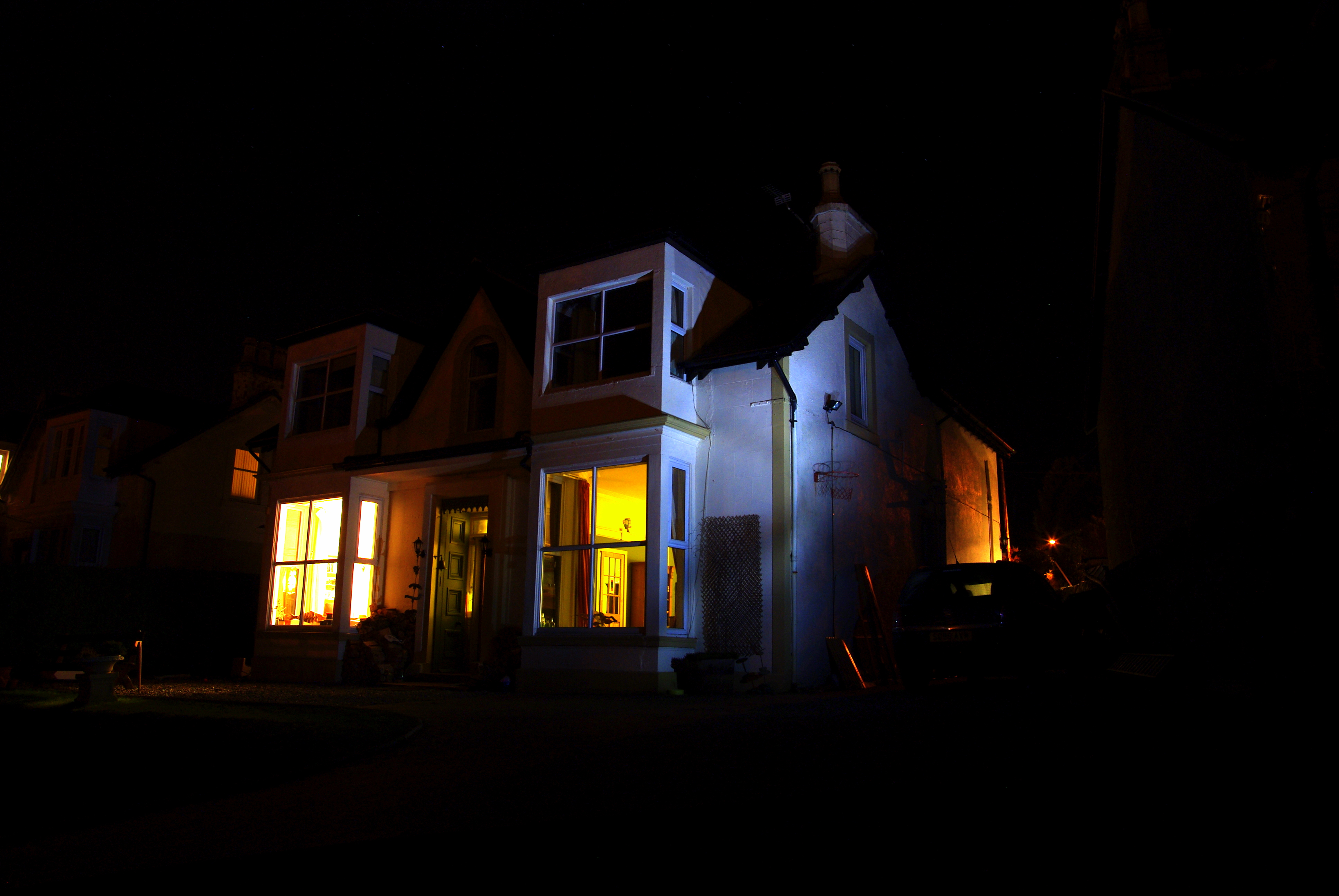
(Our house lit by a bit of slave ‘flash painting’ work on a long exposure.)
Last week we had a lovely couple staying as guests in our annex from London. This was their first time in Scotland, and they were blown away by the beauty, and even more so by the peace and quiet.
One of the things they mentioned too was darkness. The kind of darkness that you only get at some distance from light pollution that bounces off clouds and leaches into every corner. Their reaction to a walk up our drive at night was a combination of fear and wonder.
All of which led me to think about the juxtaposition of light against dark, goodness against badness, truth against falsehood, etc. All those old polarities; one of which we ascribe to God, the other we blame on the flesh or the devil.
One of which can not exist without the other.
So, light can only be understood in the knowledge of darkness. As Jesus put it;
…the people living in darkness
have seen a great light;
on those living in the land of the shadow of death
a light has dawned.
Matt 4:16
I started to think about how all of these things might exist in the mind of God.
We gathered to celebrate the failed terrorist plot to blow up the houses of Parliament today.
(Or from a different perspective…)
They gathered today to burn another Catholic freedom fighter in effigy.
The photo above freaked me a little- it looked like a man being burnt on a cross- which would be slightly appropriate I suppose.
So I chose to engage with the bonfire and fireworks (both of which I love) as a means to remember a time when Protestant and Catholic were set against one another, and truth tribalism was let loose on the land like a pack of raging wolves.
We have had a house group at our house for a number of years- some dear friends, a pot of tea and lots of chatter. However, for some time now I have been thinking that it is time to move on into something new. We have floated the idea of starting a local discussion- probably in a pub.
The are a few reasons for this- groups like ours (no matter how lovely) can simply become too familiar, too safe- and the Lion of Judah is not a tame lion. I just think it is time to step out again a little.
Next, those of us who were part of all the ’emerging church’ discussions/conversations/debates/slanging matches perhaps became a jaded with the same theological merry go round. Post modernity, post evangelicalism, post charismatic- we all embraced the questions but had no certainty about where the road might be leading- and that was fine.
But there comes a time when a new direction for our theological journey begins to become a little clearer. All those questions start to find some kind of answer, even if incomplete and held lightly.
Of late, there have been some discussions about ‘teaching’ within Aoradh. I was rather shocked at first as I was not that sure I wanted to teach anyone anything. I was happy to learn alongside others as we journeyed together, but the idea that other people should be shaped and moulded by my (or one of my friend’s) knowledge and wisdom was rather beyond me. At first the whole idea of it seemed a step back towards something that I was glad to leave behind.
But of course, St Paul talked about the gifts given to the body of the church- apostles prophets teachers miracle workers healers helpers organizers those who pray in tongues. I am no longer given to treating the suggestions of St Paul to the people in Ephesus as a blue print for the organisation of ‘church’, but neither am I going to ignore him either!
Having said that, there are a few other positions in St Paul’s list above that still have no certified incumbents. Whilst I hope that we can be respectful of church tradition, I have no real desire to start a journey towards a new clergy. Rather let us use the passion and talent that we can, and encourage the same in others around us. If we have a teacher, let him/her teach.
Or let us just gather to learn together- this still sits much easier with me.
So- if you are in the Dunoon area, do you fancy being part of a discussion group?
My working idea has been to use some of the questions proposed by St Brian of Mclaren in his book ‘A new kind of Chrisitianity’;
1. What is the overarching storyline of the Bible?
2. How should the Bible be understood?
3. Is God violent?
4. Who is Jesus and why is he important?
5. What is the Good News?
6. What do we do about the church?
7. Can we find a better way to address the issue of homosexuality?
8. Can we find a better way of viewing the future?
9. How should followers of Jesus relate to people of other religions?
10. How can we translate our quest into action?
I am determined that any of these discussions has to start and end with respect for a diversity of opinion- and even to embrace this, and if we start to fight truth wars than we will not continue!
Up for it?
Here is a taster of St Brian, talking about Questions 9- pluralism;
It is a troubled, mixed up mess of a movie- a kind of religious Mad Max with swords. What makes it interesting (if not necessarily entertaining) is the theological underpinnings of it all.
I use the word troubled, as a more dystopian, distorted version of religion than the one portrayed in the film is hard to imagine.
The central character (Denzil Washington) is walking through a post apocalyptic world. He meets lots of low life’s and chops many of them up. He ends up in a town ruled by a despot who is sending out murderous road parties in search of ‘the Book’. The book will give him the power and authority.
The book in question is a Bible, and Denzil happens to have one.
Casual sex is offered, and turned down. Sex is bad (but chopping people up is fine.)
Denzil has a mission you see- to take the Book to a place where it will be received properly. By nice people who chop people up but do not have casual sex.
Denzil gets shot, and it goes all mystical. Turns out he is blind and knows the whole book by memory.
Why the book of Eli?
Why not Matthew, or Mark, or Thessalonians?
Perhaps in part this is to do with an Old Testament perspective- all that violence, polarized good and evil. Bad things justified by the mission of God. It simply fits better into the world view of the the culture that the film grew from.
There is something else however- the centrality of The Book.
As if the only means by which God could inspire and engage with people was through the written pages of the Bible- owned and interpreted by a country full of good people- Americans, British people- like you and me.
Nothing about the Word of God made flesh to dwell amongst us.
Or the Spirit who fills us.
Or the presence in the midst.
Nothing about the central vitalising idea called love.
Nothing about the way of peace making and the open hand to the stranger.
This is the ‘prayer’ at the end of the film;
Watch it if you will (you may already have done so.) But watch for what is missing, and watch so you can look through the eyes of the machine that made the film.
And remember that they thought they were giving us what we wanted- what would entertain and engage us- not to shock alienate.
Just had a lovely evening with Samir Dawlatly, who blogs here (and writes lovely poems.) Sam is up in Glasgow attending a conference for medics, and talking to people about his passion for Chaplaincy in primary care settings (see here for more info.) He is also on the cusp of starting some kind of community/open house thing down in Birmingham and was interested to find out a bit more about Aoradh.
Sam also mentioned a bloke called A J Swoboda, who I had not come across previously. I loved this;
Aoradh have been planning some installations to coincide with Cowalfest (walking festival) and the MOD (annual festival of Gaelic culture held in a different place in Scotland each year) both which will run in Dunoon over the next couple of weeks.
We have decided to use benches along a 1-2 mile stretch of coastline. Each bench will have a piece of poetry, scripture or an activity to help with meditation.
As ever, we are leaving everything until the last minute, but if you are in Dunoon over the next couple of weeks we really hope you enjoy the things we are creating.
Will has been attending a Christian youth club being run in Dunoon by some mates of mine. He is loving it- that lovely combination of chaos, faith, music and food.
They gave him a Bible the other day and it has been sitting on our coffee table staring at me ever since- this one;
It is entitled ‘God’s Game Plan- the athlete’s Bible. Game Ready- get up, gear up, step up.” Inside are Bible references carefully chosen to support the athlete in areas of competition, performance and ‘game plan.’
Everything about it makes me cringe. The marketing exercise, the easy use of selective scripture as ‘performance enhancement’, all that ‘Jesus can make me a winner’ stuff- the mashing up of the message of Jesus with the American Dream.
Then there is this idea of ‘God’s Plan’- some kind of golden path that he has laid out for each of us, which we then have to discern through the application of good Bible study, and woe betide us if we stumble off it. I think this is a damaging idea of who God is- rather what I hope for is a God of new starts, of hope, of encouragement for us to live beautiful lives committed to the love of others.
But I said none of this to Will- he loves his new Bible. I am also very grateful to those folk who chose it for him as something suitable and encouraging.
Also, because we are not attending ‘Church’ regularly these days (as distinct from ‘church’) it is great to see him involved in other things. I remember a conversation years ago when we were discussing how we might best introduce our kids to the great mysteries of faith within the context of ’emerging/missional’ small groups. We all had lots of anxieties about whether we might be somehow depriving them of something important by being outside a large structured formal organisation, with Sunday schools, youth events and a group of peers going on a similar journey.
The conclusion we reached then was a series of questions going something like this;
Do these structured institutional means of creating faith in our young people actually work? Do we create adult disciples? Research might indicate a low success rate over the last few decades. (See summary of Church attendance figures here.)
If we as adults are modelling a dissatisfaction with those organised structures – the typical drive home deconstruction and the sharing of frustrations. What does this teach our kids if we are not prepared to work for something new, something honest and true to who you are as individuals and family?
Is it time for we parents to take responsibility for making a spiritual journey with our own kids rather than handing that responsibility to others?
Finally, we noted that in this fractured, post modern, mass communicating world, people (particularly young people) rarely have one source of information on any given subject. Rather there are multiple sources of information, from a range of physical, virtual and on line media. So it is with information about God. We might seek to control this – to make sure that information given corresponds to our own orthodoxy – but the best we can hope for is to keep channels of discussion open about all those many strands that bombard us.
So it is with our kids. They are asking their own questions about faith- assisted (hopefully) by our example, participation in Aoradh events, as well as formal (even Evangelical) events like Christian camp weeks, and youth clubs like this one. And if this means that he is exposed to the kinds of religion that I have found difficult then so be it- I need to just trust that it is is all in the mix.
Because God’s game plan is after all beyond my understanding.
Deliberately provocative (and not original,) but hopefully with good purpose…
I was listening to my MP3 player on ‘shuffle’ mode as I was working the other day. If I am near by and a song comes on that I do not want to listen to then I will press skip- as I rarely get round to deleting anything, and there is a random accumulation of all sorts of stuff on there. However I had hands covered in tile cement and so was stuck with whatever song emerged.
In this case it was Third Day, singing a song called ‘Anything’. I have confessed previously to a past leading worship music. I was that bloke with an acoustic guitar whipping up soft rock anthems. Third Day were an American Christian band that did a couple of worship albums that I really liked 10 years or so ago.
So much has changed since then for me however in terms of how I approach worship generally, and worship music particularly. Some of this can be summed up in this song – here are some of the lyrics;
And I want to hold You
Even though You can’t be held
Because You’re so much more
Than everything I’ve ever known
Anything, anything
I’d give anything
I would give anything to hold You
This song is one of many worship songs that are themed around intimacy with Jesus- and to the ears of the uninitiated, they seem to have lots in common with the language used in popular music to describe sexualised love.
A couple more examples that many of us will have sung many times. Both of them I have really loved singing in the past;
I sing a simple song of love
To my Savior, to my Jesus
I’m grateful for the things you’ve done
My loving Savior, my precious Jesus
My heart is glad that you’ve called me your own
There’s no place I’d rather be
In your arms of love
In your arms of love
Holding me still
Holding me near
In your arms of love
Then there is this one;
The simplest of all love songs
I want to bring to you
So I’ll let my words be few
Jesus, I am so in love with you. Matt & Beth Redman
To be fair, Redman appears to have been thinking about this himself, although I do not really think that this is a ‘bloke’ issue alone;
Am I being unfair do you think? All these things have to be viewed within context. If our primary (even only) expression of worship is contained within church services, then the cultural carrier of our understandings of who God is, and how we should relate to him, will be the music that we sing, and the cultural references that drive this stylistically will be all the love language that we hear in the charts.
However, I no longer primarily worship God through large gatherings, and all this erotic Jesus love language seems rather odd from a distance.
Does Jesus require this kind of devotion in our following of him? Does he value it? Does it make us better followers, more inclined to live as Agents of the Kingdom of God? Or is it a bubble of sentimental excess that has little relevance to real life?
The ‘bloody’ bit of the title of this piece by the way is suggestive of another dynamic of all these love songs- the climactic event; the consumation of the relationship, is the death of Jesus on the cross.
Once again is there anything wrong with this ? It too has to be understood within the context of a theological monoculture of substitutionary atonement. The young man whose blood had to be spilled to save the few, the carefully selected beautiful few, who have this special individual relationship with their saviour.
Except I find myself outside this context too. The narrowness of the understanding feels wrong, feels distorted, feels like ‘God made to make me feel exclusive’. God made to be mine and not yours.
Whatever the theology, there are other songs to be sung. Songs of deliverance, songs of protest, songs of lament, songs of community and songs of hope in the presence of doubt and fear.
Songs calling us to love-in-action, not just love-in-abstract.
Simon and I did a talk at Greenbelt festival about community, based on some of our experiences in Aoradh. We spoke a lot about the challenge, the exposure and the pain of community- how it was impossible to move closer to one another without also being wounded, hurt and (hopefully) changed.
If I were to pick one man to discuss this with in more detail, it would be John Vanier, founder of the L’Arche communities. He speaks and writes with such gentle integrity about his own experience of being broken. I was reminded of this recently when reading a short review of one of Vanier’s books From Brokenness to Community.
When we follow Jesus, writes Vanier, we are called to reject certain aspects of the world. We accept loss of wealth and status and comfort. We embrace downward mobility and climb back down the world’s ladder of success. This process can begin when we discover our mutual brokenness. We acknowledge our poverty and then we understand what it means that Jesus came to serve the poor. We recognize our infirmity and then we discover God doesn’t work primarily through those who think they are well, but through those who know they are sick. All this happens in the context of community—a place of pain and trial, but also reconciliation and celebration. Community is where the ego goes to die, and in its place we find resurrection, communion, and even salvation.
Here is Vanier himself talking about the same things;
It is worth watching some of the rest of the clips in this series. There is a deep sigh in me when I hear him speak about love and community and the possibilities of finding our being as we give it away in love of others. I know these things to be true.
I also know them to be elusive. I know them to be things that can not be grasped or owned- they are not aspirational as one might seek promotion or personal fulfilment- they are rather discovered in the shit of our own failure.
May we find the place of becoming, not because enlightenment is something we can conquer, like some spiritual Everest, but more because this is the only honest and hopeful thing possible when faced with the brokenness in me, and also glimpsed in others.










 this fragile tent