Is it time to change our whole approach towards mental distress?

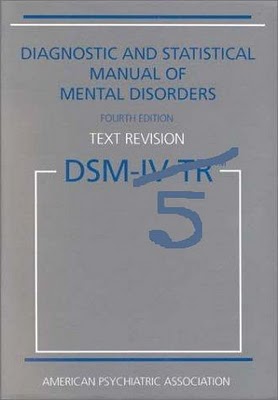
In May, the American Psychiatric Association will publish the fifth edition of the Dignostic and Statistical Manual of Psychiatric Disorders, otherwise known as DSM 5. Although originating in the USA, this publication is immensely influential, and is likely to form the basis for Psychiatric diagnosis the world over, as with the out going DSM 4.

Does it matter?

Well, the answer to this is YES. It matters on an individual level because all of us will be affected by mental disorder. One in four of us will be diagnosed according to one of the classifications above, so even if this is not you it will be someone you love or someone you work with. Lots of us feel a strange relief when distress is given a name – it suggests understanding, companionship, a removal of uncertainty and the possibility of treatment. However, for many these can easily become self perpetuating and destructive as they may have the effect removing responsibility, ownership and even hope, which some never find again.

It matters too on a sociological level. Our societies are increasingly regulated by psychiatry. We medicalise, medicate and plan ‘evidence based interventions’ into all sorts of human variation. This may simply amount to the application of science and knowledge to the alleviation of mental illness, but the question is whether this is ‘healthy’? Are we seeking to make a world in which the mess and gristle of life is edited out, tidied away, chemically suppressed? And is it working?

Psychiatric classification almost always demands treatment, so step forward the drug companies, with another product to push by fair means or foul. All those countless drug rep funded lunches, gadgets, even holidays, in the name of publicity for the next wonder drug. Even if the drugs do half of what they promise there is no doubt that our population is increasingly medicated. This from here;

Prescription Pricing Authority data shows that more than 30 million prescriptions for SSRIs (selective serotonin reuptake inhibitors) such as Prozac and Seroxat, are now issued per year, twice as many as the early 1990s. Researchers at the University of Southampton found 90 per cent of people diagnosed with depression are now taking SSRIs either continuously or as repeated courses over several years.

Professor Kendrick adds: “Our previous research found that although these drugs are said not to be addictive, many patients found it difficult to come off them, due to withdrawal symptoms including anxiety. Many wanted more help from their GP to come off the drugs. We don’t know how many really need them and whether long-term use is harmful. This has similarities to the situation with Valium in the past.”

Unsurprisingly, there is evidence that the current economic recession is also having an effect. This from the Telegraph;

The number of prescriptions for drugs such as Prozac has risen from 16 million to 23 million since 2006 with many GPs saying patients are increasingly expressing concern about the recession.

Figures obtained by the BBC under the Freedom of Information Act found the number of prescriptions for the most common group of antidepressants rose by 43 per cent during the period covering the banking crisis and housing crash.

If we can agree that in terms of practice, prescription and intervention psychiatry is increasingly involved in our lives, then the emergence of a new set of diagnostic criteria must be a considerable significance to all of us. We should also know then that this classification process, already controversial, is in the middle of a storm of criticism following the release of advance details of the new DSM 5.

Firstly, what could be regarded as the ‘tabloid headlines’. This from here;

Bereavement, which has always been excluded from the mood disorders, will become a mental disorder. Mild forgetfulness will become a mental disorder (“mild neurocognitive disorder”). Your child’s temper tantrums will become a mental disorder (“disruptive mood dysregulation disorder”). Even preferring one of your parents to the other will become a mental disorder! (Yes, really: “parental alienation disorder”).

You will need to display fewer and fewer symptoms to get labeled with certain disorders, for exampleAttention Deficit Disorder and Generalized Anxiety Disorder. Children will have more and more mental disorder labels available to pin on them.  These are clearly boons to the mental health industry but are they legitimate additions to the manual that mental health professionals use to diagnose their clients?

You can listen to a short Radio 4 Today Programme debate on some of these issues between David Kupfer who chairs the DSM 5 committee for the American Psychiatric Association, and Peter Kinderman, professor and honorary Consultant Clinical Psychologist with Mersey Care NHS Trust about this between on this link.

Then there is the murky world of classification of ‘personality disorders’. Many people regard these as the ultimate examples of how abstract description of patterns of behaviour can become viewed as some kind of unassailable concrete ‘illness’, which then take on a reality in the same way as we might understand influenza or cancer.

DSM 5 complicates this further by adding more categories, for example “Apathy Syndrome,” “Internet Addiction Disorder,” and “Parental Alienation Syndrome”. This has raised so much concern that the American Psychological Association has begun an on line petition to allow people to express their concerns. This from here;

It is particularly concerning that a member of the Personality Disorders Workgroup has publicly described the proposals as “a disappointing and confusing mixture of innovation and preservation of the status quo that is inconsistent, lacks coherence, is impractical, and, in places, is incompatible with empirical facts” (Livesley, 2010), and that, similarly, Chair of DSM-III Task Force Robert Spitzer has stated that, of all of the problematic proposals, “Probably the most problematic is the revision of personality disorders, where they’ve made major changes; and the changes are not all supported by any empirical basis.”

How about this side of the Atlantic? This from the British Psychological Society (not renowned as a radical organisation) response to the consultation;

The Society is concerned that clients and the general public are negatively affected by the continued and continuous medicalisation of their natural and normal responses to their experiences; responses which undoubtedly have distressing consequences which demand helping responses, but which do not reflect illnesses so much as normal individual variation. (p.1)

We believe that classifying these problems as ‘illnesses’ misses the relational context of problems and the undeniable social causation of many such problems. For psychologists, our well-being and mental health stem from our frameworks of understanding of the world, frameworks which are themselves the product of the experiences and learning through our lives. (p.4)

These comments go to the very heart of how we approach mental distress.

The Hearing Voices Network have been making a case for change for many years. Psychiatrist Marius Romme for example claimed that many people who hallucinate “are like homosexuals in the 1950s — in need of liberation, not cure.”

There is a change underway, akin to that of other great liberation movements and I believe that when we see chains on people it should be the intention and hope of the followers of Jesus to seek to break them. What is unfortunate is that the classification found in DSM5 do little to break chains. If anything DSM5 might yet forge new ones and as such, we should resist…

How might they be broken then? Here is my reading of (and my hope for) some of the changes;

Away from ‘illness’ towards ‘distress’

Away from ‘symptoms’ towards understanding that we develop different  means of coping with this distress.

Away from restrictive labels towards listening to individual experience.

Away from medicalised interventions, towards encouragement and support of individual recovery.

Away from simplistic distinctions between ‘psychosis’ and ‘neurosis’ towards a greater interest and understanding of the effect of trauma.

Away from segregation and ‘otherness’ towards seeing mental distress as an essential part of the human experience and as such, part of all of our experiences.

Away from ‘maintenance’ towards, hope.

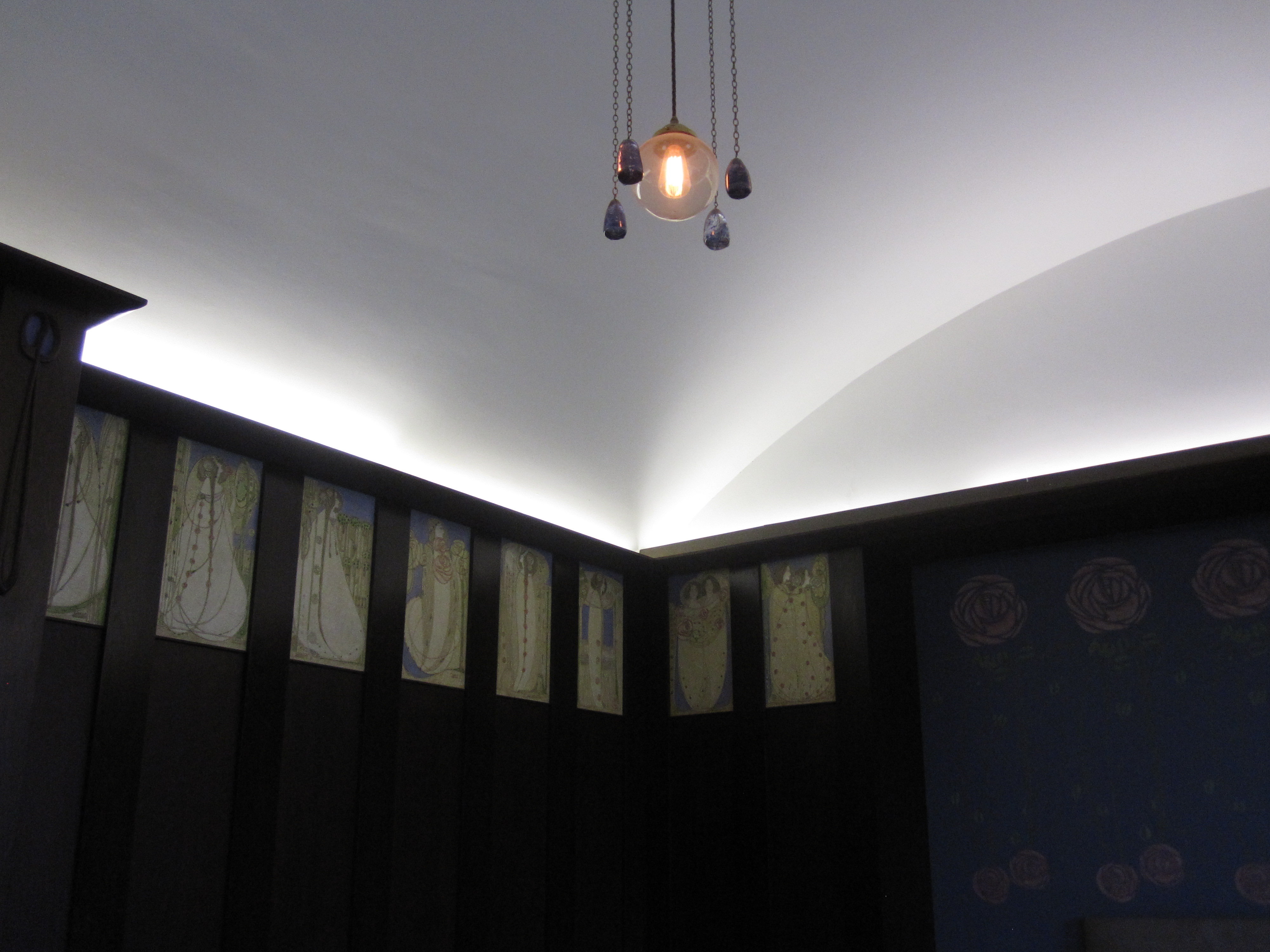
House for an art lover…

Ahhhhhh, home.

Today I rose at 7.00am after around 4 hours sleep, and drove to Glasgow to take Will to a Gaelic drama event. We then went to buy a car (always one of my least favourite activities) as the long Argyll roads are taking their toll on our current one. Later we watched William’s play, then (another of my least favourite activities) went to the dreaded IKEA to buy bedroom furniture.

Apart from being a very expensive day, it was also an exhausting one.

However, in the middle of all this, Michaela and I had a a couple of hours to kill in the middle of Glasgow, so we took the time to visit this place, which M had been wanting to go to for years. She is a lover of the interior designs of Charles Rennie Mackintosh and was in her element. The house was not actually built by Mackintosh, but was finished only around 10 years ago, to designs that Mackintosh entered in to a competition.

There is even a piano incorporated into his design- which I sat playing for a while, until I realised that I had attracted an audience.

The spaces that Mackintosh designed has been faithfully created without the need to pander to the domestic requirements of real live clients (unlike the other CRM house that has been preserved intact, the Hill House.) He wanted no ‘art’ on the walls, no clutter on the mantelpieces- in fact, he designed the fireplaces deliberately without any kind of shelving. He wanted the house itself to be the art to be loved. If you wanted other kinds of art, then it should be tidied away afterwards into cupboards.

I am not sure how I feel about this place. The spaces are undeniably lovely. The light falls through the illuminated panes, and finds all those lovely organic shapes. But there is an esoteric exclusivity about it too. Like lots of the art that we inherit,  it depends on the excessive wealth of the minority who could afford to indulge their own interests and tastes. What do you do if you have more than you could ever want or need, several times over- after you have done a bit of philanthropic giving to assuage the conscience?

You commission some art of course.

I am being unfair I think, as without these people lots of art that moves millions would never have come into existence.

And I like to think that my house too is for art lovers (note the plural) but let’s not lock it away. Let it be the oil between us.

Still, after all it is lovely and if Michaela likes it that is good enough for me…

Square world…

I went for a meeting today in a posh new hospital. Everything squeaked as if in disapproval of my polluting presence.

I was there to chair a meeting about one of the patients, who had been transferred there recently to receive more specialist care. She had previously spent most of the last 40 years of her life as a resident of the local psychiatric hospital. Things went wrong after the death of her husband, and she somehow lost herself in the grief of it all. The whole range of psychiatric science was rolled out for her benefit – drugs that greyed her vision, Electric Shock Therapy that blew holes in her memory then finally psycho surgery in an attempt to cut grief out of her brain with a scalpel.

And here she remains – toothless, but given to scratching. Occasionally abusive but still with sense of humour intact.

She used to be a worker, a wife, a mother. She used to go on picnics and loved to dance. She enjoyed holidays and gossiped with her friends about the comings and goings of the village.

But that was 40 years ago.

Today we met to discuss her future care – a likely move to a specialist nursing home, and the legal issues around that given her lack of capacity to understand or to give consent.

But in the middle of this, she looked at the ceiling and said;

I hate those squares. Everything is square in here. Put me outside next to the beech hedge. Just put me outside.

And I looked out at the brown beech hedge, with dry leaves still rattling on the close cropped branches.

Through the square window.

And I wanted to wheel her out there, and sit her under the winter sky, wind waving her long grey hair in a curve of protest against all those bloody awful squares.

A day of possibilities…

They don’t come along often. Sure there are always choices that we can make but most of the time the road leads in one direction. But I am approaching a junction though.

Three ways diverge. One is promotion in my current work, the other demotion. I can choose either of these versions of ‘more of the same’.

The other road is far less certain. Once again, there is a more than even chance of being offered voluntary redundancy. I should be getting a letter by the end of the week asking me to put my cards on the table.

Take the blue pill.

Make the jump into the unknown.

Burn my bridges.

If I take this option there are no guarantees that it will not go badly wrong. We have talked about a variety of other ways of making a living- B and B, art, retreats, writing, crafts and pottery, but these are fairly untested.

The penalty for failure in terms of impact on myself and my family would be catastrophic.

But despite all of this the possibilities of the uncertain road are calling me…


Community and the social core…

I joined this site recently, thanks to a contact on my blog because of an old post about Poverty and the Emerging Church.

‘Our Society’ is helping to join people together for good – to exchange ideas and information and encourage community action, and as such it seems like something to shine light and sprinkle salt on.

The site is focussed south of the border at present, so it would be great to get some Scottish participation.

Gavin Barker sent me this power point in relation to work he has been doing to map areas of social deprivation;

<div style=”width:425px” id=”__ss_11131652″> <strong style=”display:block;margin:12px 0 4px”><a href=”http://www.slideshare.net/Gavman/imd-our-society&#8221; title=”Mapping deprivation and co-production” target=”_blank”>Mapping deprivation and co-production</a></strong>

The slides about the importance of connections and ‘social capital’ are very familiar, but the idea of a ‘social core’ was less so to me.

The measure of our societies depends to a large extent on the community activists at the heart of our towns, which Gavin describes as the ‘social core’ who tend to be

•Middle aged
•Have higher education qualifications
•Owner occupiers
•Actively practice their religion
•Have lived in the same neighbourhood for at least 10 years
•Over 60% of middle aged females would be counted as part of the civic core
~
These folk will do 72% of the civic participation, 79% of the charitable giving and 87% of the voluntary hours.
~
Gavin also talks about the ‘inner core’ – the 7.6% of the population who do 22%, 40% and 49% of the above.
~
I would add to this (from a small town Scottish perspective) that these people are also often incomers- that is, migrants into the area, or ‘white settlers’ as they are disparagingly known.
~
You could legitimately argue that the description of the social core above is simply those who can afford to spend time, money and energy on these things. Other people are caught up in surviving. However; whatever the reason, whatever the motivation, thank God for them, particularly in these times of disconnection and fragmentation.

Scottish independence?

So, the issue of independence for Scotland from Great Britain is at the top of the political agenda.

Tory leader, David Cameron decided to force the issue and in the process managed to give a political boost to the Scottish Nationalists – any posh London Tory who tries to flex his or her muscles up in Scotland is going to be resisted by 90% of the population up here. As someone said, there are more polar bears in Scotland than Tory members of parliament!

I have written before about my own take on all this which is pretty much along these lines-

  • I am an English/Irishman, living in Scotland. Most of us are part of a similar mix when you scratch the surface.
  • I have an innate suspicion of nationalism as I can’t think of a single instance of nationalism being a force for good
  • Rather nationalism is often associated with ‘us first’ – defended boundaries, exclusivity and sectarianism.
  • This is particularly the case in when politics starts to use history as a justification. It all becomes distorted and dishonest

Does this mean that the 5.2 million people who live in Scotland (8.5% of the total UK population) could not benefit from independence? The answer to this of course is that no one really knows. The economic case is yet to be argued, not to mention the wider political implications for the whole of the UK. The argument has been really stuck at some kind of romantic notion of ‘Scottishness’, which is of course defined AGAINST as much as defined by.

Defined against the English that is.

Typified by the proposal (by the Scottish Nationalist Party) to hold a referendum on the 700th anniversary of the Battle of Bannockburn. Because Robert the Bruce has more to teach us about our politics than all those intervening years of Empire and conquest (apparently.)

Is it possible to love your country without seeking to denigrate your neighbours? I hope it is for the sake of the future of these islands. I hope we can promote the politics of reconciliation and respect. I suppose nationalists in Scotland would argue that this is only possible when there is an equal partnership, or even genuine self determination.

I read this recently, which paints a strange picture of views on this issue either side of the border –

The poll shows that while a substantial proportion of Scots (40 per cent) back independence, 43 per cent want to remain inside the United Kingdom.

However, among English voters – who would not get a vote in any referendum – there is a clear lead for those who support independence for Scotland (43 per cent) over those who want the Union to be preserved (32 per cent).

Most Scots admit their nation would be worse off after independence (41 per cent) than better off (38 per cent), while 51 per cent of English think the Scots would be worse off.

Some 61 per cent of English people, moreover, say the current formula which sees higher government spending per head in Scotland is unjustified – a similar finding to 2006.

Among Scots, 53 per cent think that the spending system, known as the Barnett formula, is justified while 21 per cent do not agree.

So will it happen?

At the moment I would say that the odds are against, but I hope that over the next year the questions asked will be much more sophisticated ones, rather than just the agenda that is set by the Edinburgh Tartan Elite.

Looking forward to a few things…

This photo was taken looking out from the viewpoint at the top of Benmore Gardens today, where we took a picnic today, along with some friends. It somehow made me think of the year to come; looking forward into 2012. It suddenly seemed so hopeful and exciting to look forward, rather than looking back…

I love to have things on the horizon – distant goals/projects/destinations that I can move towards, even if getting there involves some graft. I think this is always even more important to me in the dark months of the year. So I started to write a list.

Yesterday we worked hard in our cellar, to continue the process of converting the space down there to a working pottery. Michaela and Pauline’s Blue Sky Craft Workshops will be planning some sessions down there. Watch this space if you are interested. I’ll post some photos when I have managed to build some of the workbenches down there.

Talking of craft/art we have  been asked if we want to use the exhibition space in Benmore Gardens- to fill it up with carvings and craftings. This is a lovely challenge, as it is a big space, and so it will need some big pieces, possibly combining work from different members of our group. Time to get in the workshop, and tidy all the things that have come out of the cellar into some kind of order!

Then there is the distant Greenbelt festival- which has become increasingly important to me also. I have a few ideas for poetry/audio installations that I am gathering soundscapes and ideas for. Not sure if it will happen, but the creativity it sparks in me is grand.

In all this mix is lots of uncertainty. A job that has been under threat for two years but may be about to finally end. Other plans to downshift and start all sorts of other micro enterprises have been long in the planning, but this will be the year one way or another, when things will change.

Then there is the Wilderness Retreats that I am planning with my mates Simon, Nick and Paul. I am really looking forward to these. I hope some of you will join us.

Then there are all the activities of the community I am part of – Aoradh. We meet to eat and laugh and pray, and to plan creative ways to celebrate our faith. Next year we are already talking about collaborations with others, bench meditation spots, community gardens, labyrinths, prayer rooms.

And to mark progress towards the new season, today Will and I attended the first of the years indoor cricket net sessions. We spent a couple of hours bowling, being bowled at and facing a bowling machine. Magic. It is hard to imagine the warm days full of the sound of leather on willow, but this too will come.

As I look at this little (incomplete) list, I feel blessed, excited, hopeful, humble, grateful. And perhaps just a little overwhelmed.

May your horizons be full of good things too!

Personal growth and the rise to the top…


Life is for living – for drinking deep from the well of experience. That is why many of us believe that wild places are so special; they take us out of our narrow protected bubble and open up something deeper, more eternal.

A fulfilled life is a difficult thing to measure. Very soon we start to use nebulous words like ‘well being’, ‘happiness’ and ‘satisfaction’.

We may also have to acknowledge that life is a process – a journey. Some would call this journey a process of ‘maturity’, others would say ‘enlightenment’, others still would call it ‘personal growth’. All these ideas contain the idea that life, in all its joy and difficulties, should embrace transformation; movement from one state of being to another. Standing still is unlikely to be healthy and ultimately it will likely prove impossible.

For a while, many of us (particularly men) come to believe that a fulfilled life is one characterised by success. And because we are competitive creatures there has to be some means of measuring this success so we are always heading for the next achievement, the next conquest, the next acquisition.

I was reminded of this again today listening to a radio discussion about psychopathy with Jon Ronson, author of this book

The word ‘psychopath’ is one of the most overused and emotive terms employed by the media in relation to mental illness, but Ronson’s book goes far beyond the stereotype. He qualified to use the Hare Psychopathy Checklist, and became, by his own admission, something of an obsessive Psychopath spotter.

Whatever you believe about the usefulness of labels like this, the fascination with the sort of people who can commit such acts of appalling cruelty apparently guilt free is almost universal. All the more sobering then is the statistic that roughly 1% of people can be regarded as psychopathic.

Rather than getting stuck with all the high profile serial killers and despots, Ronson’s interest takes us more towards the very place of madness at the heart of our society. At the same time as vilifying psychopaths as not-human ‘others’, he argues that there is something psychopathic about our society, and that many parts of our society actually reward psychopathic tendencies.

Consider this – one of the two ‘factors’ in Hare’s checklist

Factor 1: Personality “Aggressive narcissism”

It is easy to see how an individual with these kind of characteristics could succeed in much of society. It is impossible not to start thinking of people we know, bosses we have had.

I went to hear psychologist Oliver James speak at Greenbelt Festival last year (you can download the talk here.) One of the things I remembered him saying was that in all his dealings with the rich and powerful, including several Prime Ministers, he had yet to meet many who he would regard as psychologically healthy.

However, Ronson goes further than this and suggests that the very institutions of our society can become psychopathic. Banks that loan what they know can never be repaid, therefore condemning people to financial indebtedness for the rest of their lives. Health systems that thrive on the sickness of the population. The creation of all sorts of addictions to gadgets and shiny product in order to ensure profit.

It is almost as if the process of becoming – whether we understand this as a spiritual, psychological or simply biological development – has been replaced by a process of conquest, where success at almost any cost is the only thing that matters.

But success is fickle. The journey to the top is often followed by the journey back down again.

Back to this maturity/enlightenment/personal growth thing. Most of us come to a point when we realise that success is rarely a route to any kind of lasting happiness (even if this is a legitimate aim for any of us.) A life that cuts us off from the social animal that we humans are and replaces this with narrow acquisition is a kind of madness – all the more so for the fact that it is a collective madness.

So for those of us who are climbing to the top, may we succeed. May our enterprises go from strength to strength. But may we also remember that success without ethical responsibility and without the mess of all that humanity may indeed still be success, but it may also be the cause of our own destruction – both individually and collectively.

The Wayseer Manifesto…

I watched this today (courtesy of the Emergent Village ‘minimergent’)

This from their website

All over the world there are Wayseers who struggle, who hide their gifts, because they don’t realize what they are. We are here to find Wayseers throughout the world and let them know how important they are to humanity. We are here to turn Wayseers on to their rare aptitude for leading transformation.

When the Wayseers of the world are awakened to their true calling on this planet, a massive shift in the human condition will occur.  Wayseers are the change agents of humanity – the innovators, the healers, the visionaries, the spiritual leaders, the entrepreneurs, the ones who are here to lead humanity into alignment with the Way.

I think I like it. Or at least some of it

I like the idea of the need for agitators, damaged malcontents who will not be defined by their limitations. The passion for something better, something other, something more creative and beautiful.

What I am not so sure about is the degree to which we exalt the ‘event’ over the ‘ordinary’, and the idea that we can all be ‘extra ordinary’ if we believe strongly enough.

And perhaps the ‘out there’ charismatic presentation is just a bit too God channel to sit easily with most of we Brits. The handsome bloke who comes and tells us that we are part of the special 10%. And he has product to shift.

There is also this strange feeling of activism as an end in itself – divorced from dogma, or from ideology, or cause. We want transformation, but we do not define what we are transforming to- this will work itself out if we follow ‘the way’. ‘The way’ is enough- the ‘calling’ we all carry. As I think of this, it seems to me to reflect a real shift in society – even a shift in me.

Society is less interested in what you believe, more in what lights you up. And just about anything goes man, what ever turns you on. And right now, we all need to be turned on to something new- the old stuff is over, bring on the next…

But I too feel the pull of this thing called ‘the way’. It seems to me that the Kingdom of God (as I would call it) is located within and without the followers of any one religion. Jesus broke all those barriers for ever. The way is enough- the calling to follow, to journey with love in an uncertain direction.

It seems to me that the Kingdom of God beats like a pulse in all of those things associated with ‘the way’ listed above.

Perhaps I should take up skateboarding.