TFT- new address…

I have now used up my ‘free’ storage space on WordPress- which means I have had to upgrade my package and start to PAY to continue to write on this site! I weighed up starting again on a new platform, but for now have decided to pay the £60 a year to go for an upgrade.

Part of this involves being able to purchase ‘thisfragiletent’ as a permanent URL. The address of this site will now just be http://www.thisfragiletent.com. (The old address will work too though.)

All of which forced me to review again why I am doing this- why I persist with this strange (mostly) daily addiction. I was reminded of this old post, which made reference to this list from TSK-

1. Praise (public acknowledgement) – “publish glad tidings daily”
2. Accountability. (Eph. 5: 21 “Submit yourselves to one another”, quote fromAthanasias)
3. Vulnerability (Daniel’s window)
4, Given-ness (Freely you have received, gift economyProv 11:24)
5. Creative Naming (Adam, Neighbors in Ruth)
6. Repentance (editing/deleting/changing our mind in new media)
7. Fellowship (hypertext linking, Koinonia)
8. Evangelism (storytelling, blogging from our lives)
9. Integrity (writing matches our speaking, design reflects reality)
10. Posterity. (store/guard what has been entrusted, writing history)
There was also another one: Watchfulness (“watch and pray”).

To which I added;

11. Creativity- most writers would say that words shape us as we shape them.

12. Discipline and long term commitment- blogging output varies, but it demands mostly daily commitment over a long time to develop a voice.

I think this lest still works, more or less, so blog on I will…
Was anyone at Greenbelt festival circa 1985?

I don’t think I was (my sister Katherine will remember) but I was there 83 and 84.

I was transported back to my 18 year old tortured self through these clips however;

The festival is very different now – although so am I – both of us have lost our innocence I think. Everything is more nuanced, more self consciously de constructed perhaps? Perhaps you disagree…

As I watch these clips (and there are a few more on you tube) I am reminded all too painfully of the boy I was- with all this confused idealism and awkwardness, in the middle of which was a simple, beautiful place called Jesus. Sometimes he was the only thing that made any sense.

This much has not changed.

Jubilee approaches…

I am in a strange place at the moment- all about transition. The ending of one thing and the step into an uncertain other. It is on the whole a good place, but not without it’s physical and psychological challenge. I have less than two weeks left in my current job (perhaps even my current career) and then I plunge into a time of relative free fall.

There is a plan of sorts- I will have some redundancy money that will keep us going for a little while and allow me to invest in alterations to the house. We hope to have two double rooms available for holiday letting/bed and breakfast by the end of the summer, which (along with our self catering accommodation) will allow us to make some kind of a living through hospitality. Our real hope is that we can start to offer a combination of activities around the old house- retreat weekends, pottery courses, outdoor activities etc. (We have a FB page and a website if you are interested to see where things are up to at present.)

I also hope that I get some time to spend writing. It is perhaps what I love to do most- a private secret thing that may well have no external application, but if I do not give some serious effort towards, will be a source of regret.

Then there is social work- I am not entirely sure I am done with it. I hope that in the process of stepping off the tread mill I might rediscover some of the passion and idealism that made me a social worker in the first place. I will probably need to do some part time work too.

On Sunday, during our Aoradh family worship day, Andy spoke about slavery. He described the context of slavery in the time of Jesus- people born into slavery, captured there in war, or selling themselves into slavery in order to cope with life or debt. Andy made the comparison with our relationship to money in our age- which (given what I have said above) clearly resonated with me.

We are all caught up in things that hold us, for good or ill. Some of this we fell into out of the womb, some caught us through circumstance, yet others we willingly tie ourselves to. Often it seems that these things become bigger than us- they offer us no choices, no release; we become slaves.

There is this other word however, which we have heard rather a lot of over this year in the UK- Jubilee.

I am not talking about elaborate celebrations of the anniversaries of monarchs, but as Wikipedia puts it;

The Jubilee (Hebrew yovel יובל) year is the year at the end of seven cycles of shmita (Sabbatical years), and according to Biblical regulations had a special impact on the ownership and management of land in the Land of Israel; there is some debate whether it was the 49th year (the last year of seven sabbatical cycles, referred to as the Sabbath’s Sabbath), or whether it was the following (50th) year.

“This fiftieth year is sacred—it is a time of freedom and of celebration when everyone will receive back their original property, and slaves will return home to their families. “
My Jubilee is not a release from bondage into some kind of utopian ideal- and I am sure it never was for the Hebrews. It just signifies for me the simple fact that making risky shifts in the fabric of our lives is a rare privilege.
.

What might God say to a teenager?

We are helping to set up a prayer room to be used as part of a Scripture Union camp run by some friends next week. I was asked to write a letter to be used as part of the event.

It was not an easy thing to do- there is a gulf of years from by own teen age, which was more than a little dysfunctional.

There are also my own kids- well on the way to becoming whoever they are to become.

How might they come to encounter that part of themselves that is Spirit? This is not in my power to command, although I might hope to be a window through which they can look.

In the end, I wrote this;

Dear……….

I hear you have been looking for me.

I listened to your questions about the meaning of it all; about where this wonderful world came from and where it might be going. I listened too to your hopes and your dreams and they filled me up with joy.

Because inside you are the seeds of my Kingdom.

I understand that all of this may seem mysterious and difficult to understand, but we are not done yet.

I understand too that sometimes you wonder if I am here at all.

Keep looking my child, because those who seek will find. Those who knock on doors will yet see them wide open.

Sometimes I will look at you through the eyes of someone you love. You will hold on to another and have no idea that it is my hand you are holding.

Sometimes I will smile at you through sunsets. I will cry with you in the summer rain and light your dreams with starlight.

You might find me too in old stories and songs written by other people who looked for me.

Some of these stories are about Jesus.

Stories of great things- lives changed, hungry people fed, broken people mended.

Stories of revolution. Stories that turn everything upside down. The small people stand tall, the first become last. The powerful and strong find that their kind of power has no place in my Kingdom.

Because my Kingdom is found in you.

The patterns of Paisley Abbey…

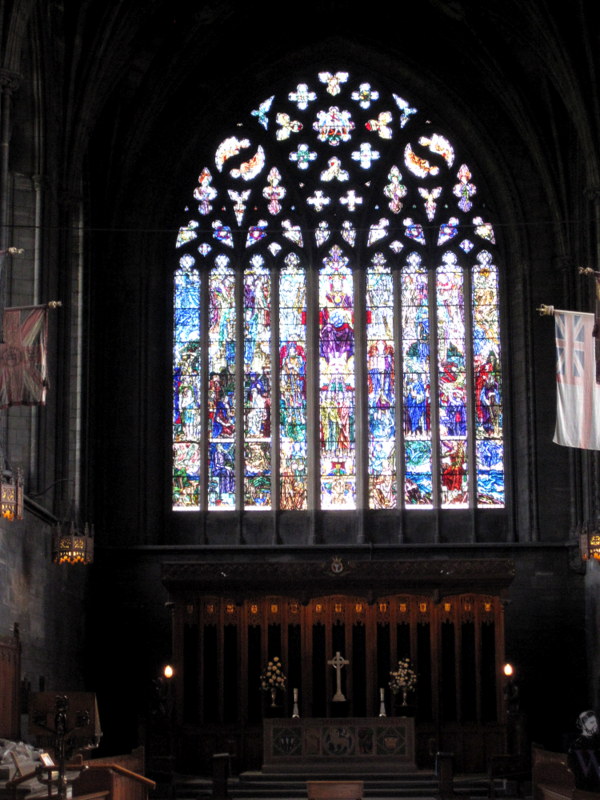
Yesterday we were in Paisley and called into the lovely old Abbey.

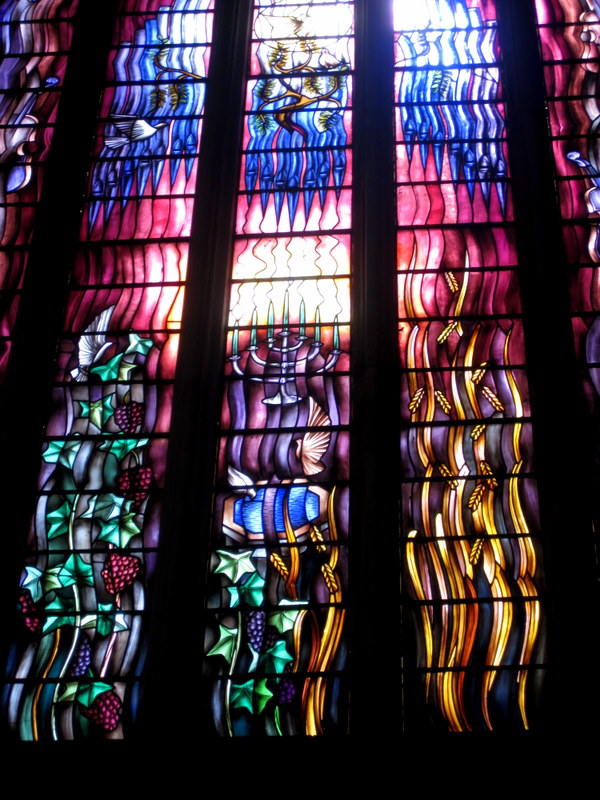
It dates back to 1163, when it was established as a Cluniac Monastery- followers of a Benedictine order in France, who established a strict regime of austere living. Despite this however, there was also a tradition of giving the very best to God, particularly around worship, so alongside the extreme frugality of individual monks there was great opulence and wealth within the actual priories, hence this lovely building, which would have been decorated in the most colourful way with gold silver and the finest fabrics.

This contrast between simplicity/self denial and great wealth and power is one that always hits me when I attend the wonderful architectural survivors of the the former religious age. Such resources went into their construction- and continue to be tied up in their upkeep, and this seems at odds with the way of Jesus.

However- who can be in such places and remain unmoved?

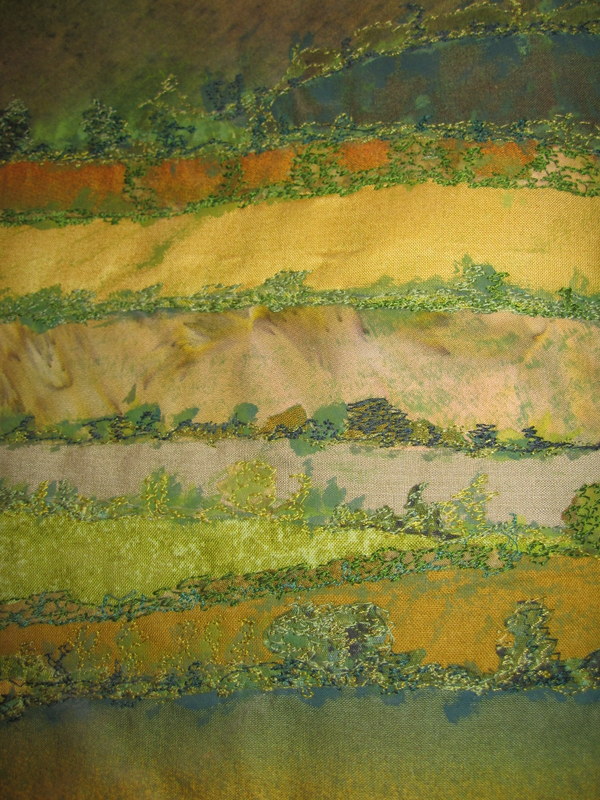
Here are a few photos of some of the colour inside the place, taken with M’s little camera…

Where we are from…

My father is visiting at the moment.

We did not know each other until a few years ago- a long story of a broken family and much distance created, and it was not until my 40th birthday that we met again. Since then we get together fairly regularly.

The obvious question this brings is; what of me comes from him?

In some ways we are quite alike. He is quietly spoken, rather shy and tall. In other ways, it seems we are creatures from a different world. He has a thick Irish accent, and hardly went to school (I suspect Dyslexia, which lots of other people in my family seem to have too.)

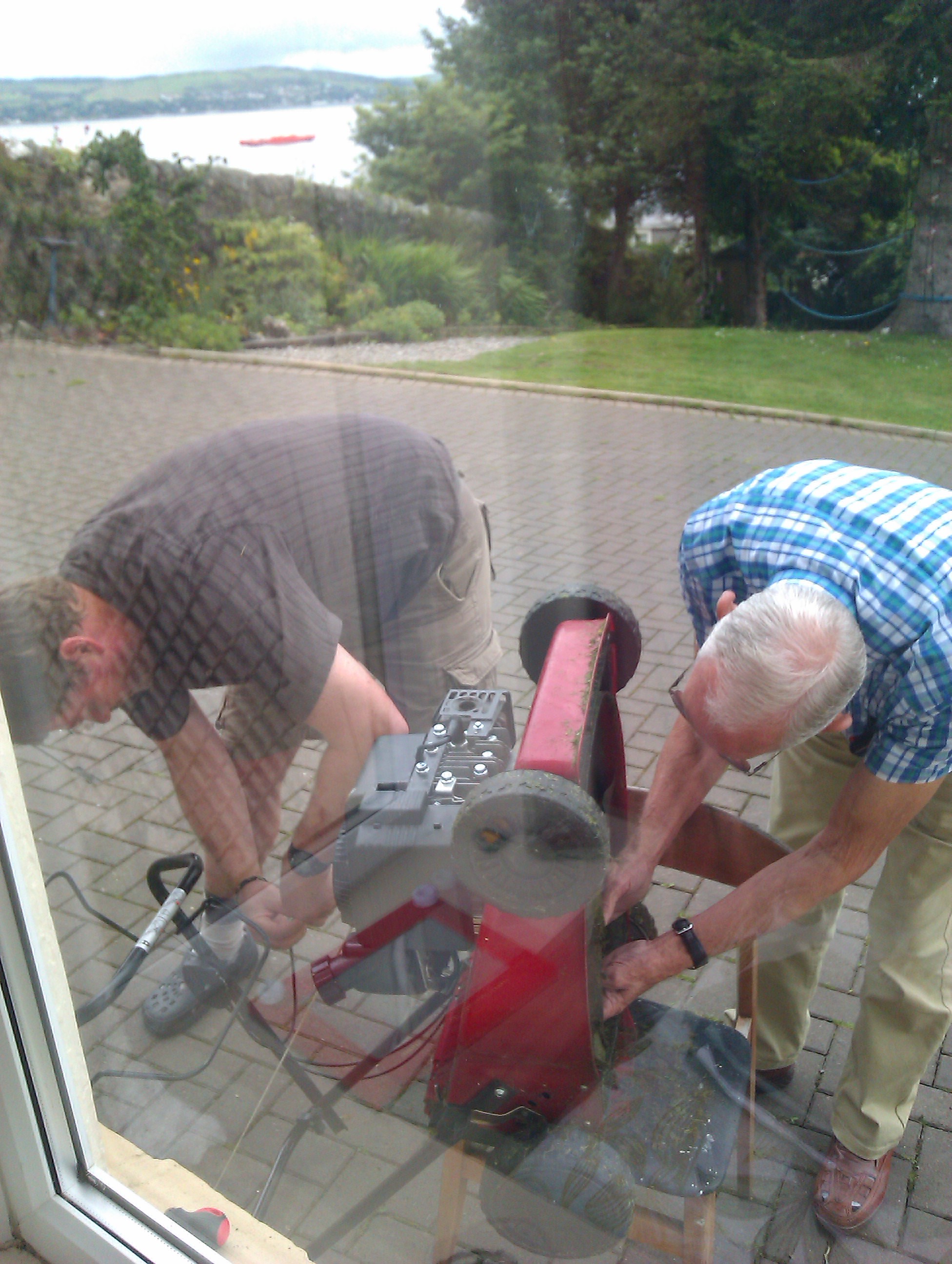
Today however, we mended a lawn mower, and it occurred to me that we both have some natural affinity with tools. We can make things and mend them. Emily took this photograph through the living room window;

The other thing I discovered was a connection to cricket!

My dad grew up in a tiny place near Strabane in Northern Ireland called Sion Mills. He was the youngest surviving child of six brothers and sisters, and both parents worked at the local Flax mill, and died young as a result of problems with dyspnoea associated with the fibres.

The mill also had a cricket team, reputed to have beaten a touring Australian team. They may have had some help from the Bushmills.  The team was once the most powerful club side in Ireland, and also holds the record for the biggest hit in cricket history. The ball landed in the goods wagon of a passing train and was recovered in Derry, 17 miles away.

I came across this clip from another game played at Sion Mills between Ireland and Clive Lloyd‘s West Indies. You can see the old Mill in the background.

I assume that the West Indies players had been liberally entertained.

The least of these…

Massed graves.

A State in which it is estimated that “8,000  non-combatants had vanished from army custody in a state the size of Ireland – four times more than disappeared under Pinochet in Chile.”

A place where hundreds of soldiers accused of rape, murder, torture- and not one single case has made it to court.

A state in which Human Rights Watch suggest torture is an endemic, systematic tool of government. Methods included branding, electric shocks, simulated drowning, striping flesh with razor blades and piping petrol into anuses.

A place where citizens are dealt with using a ‘Public Safety Act’, under which they can be jailed, preventively, for two years, if deemed likely to commit subversive acts in the future, with an estimated 20,000 detained, according to Human Rights Watch.

Cities and towns where children are regularly shot in the streets during public demonstrations.

A place where in 2008 a lawyer to make a terrible discovery. While surveying disappearance cases in villages he was shown a hitherto unknown network of unmarked and mass graves: muddy pits and mossy mounds, pock-marking pine forests and orchards. According to eyewitnesses, all had been dug under the gaze of the security forces and all contained the bodies of local men. Some were fresh, others decayed, hinting at a covert slaughter that went back many years. The lawyer widened his search, mapping almost 1,000 locations. This has since risen to 2700. He has continued at direct threat of his life- losing many friends along the way. He was awarded  the Ludovic-Trarieux International Human Rights Prize, first given to Nelson Mandela, he was unable to accept it in person as his government declined to issue him a passport.

Were is this terrible place?

Can you guess?

Why are we, the agents of the Kingdom of God, not scandalised? Why are we not using what we can to raise awareness, and to demand our government speaks on our behalf against such abuse?l

By the way, the country where the events above are happening is India. Kashmir to be precise. A beautiful mountainous Indian ruled majority Muslim province on the embattled frontier with Pakistan. Check out this article for a fuller account of the things described above.

Perhaps the list of events are not a surprise to you- either because you are better read than me in relation to international events- but I think that most of us will know very little about the conditions that Kashmiris live under. Beyond the stories about the dreadful earthquake a couple of years ago (in which over 70,000 people died) and the odd account of shellfire across the border, Kashmir is ignored by our media.

I wonder why? Is it because India is on ‘our side’? A democratic free market economy, in which things like this can not take place? Is it because the other side of the border lies Pakistan, with its military dictators, and Muslim extreme views? Or is it because it is simply so far away, and involving people who are not really like us- they are a different colour and creed…

Whatever the reason, shame on us.

If you want to read more, then check out some of these links;

KashmirWatch.

Channel 4’s up coming documentary Kashmir’s Torture Trail.

Human Rights Watch.

Leaderless organisations…

I have been thinking about leadership again of late. This is in part because the group I belong to Aoradh has had to tackle some thorny issues without a ‘leader’ as such recently and we are not part of a wider network from which external advise/encouragement might be sought.

The way Aoradh has stumbled upon doing leadership is something like this;

  1. We started out very task centred – we were promoting a festival – for which an organising committee was more than enough. We asked one of our members to take leadership of this committee, as we were a disparate group and there was a need for clear communication with media/professional clergy/local authorities.
  2. There was a process of chaotic competition of ideas and principles concerning what we were about. Some people left, and the ones left were mostly in the process of considerable change- and this was reflected in what Aoradh was becoming. The group was small enough not to need ‘a leader’ and there was general resistance to formality and structure.
  3. Aoradh progressed from task focus towards an increasing community focus. More people joined, some left. There was a real sense of freedom to do things differently, which was highly valued in particular with people who had been part of hierarchical and even oppressive church structures. Because of this, despite a general feeling that leadership was an issue, we just decided to defer it.
  4. So we entered a period in which leadership was mitigated according to specific tasks or events. We met regularly to decide business collectively, and different people either took or were asked to take leadership for specific things. For example, Michaela is a natural organiser, so tends to circulate dates, and keep us on track. I am a dreamer, so always have my eyes on the next thing, the coming horizon. Andy is practical and technical and so will always want to roll his sleeves up etc etc. And for the most part, it works with very little conflict, and only a little confusion.
  5. There are of course different levels of comfort with this process however. It can be messy and frustrating, particularly for those more structurally-minded. The best we can say now is that leadership is still a work in progress.

Along the way I have found some ideas useful to inform our debate;

Grace

Jonny described a similar process as ours that Grace went through. They too decided to ‘defer’ the leadership question- and did so for years it seems. Eventually however, a structure did emerge in the form of a leadership group that rotated annually, and had the task of ensuring that the principles of the Grace were upheld and protected.

The common table

I read an article by Mark Stavlund, who is part of a community called ‘The common table‘, describing a kind of process that he called ‘negative space’. I wrote about this here. Mark describes a process of leadership in small groups that very much fits our current model.

There is an old idea about leaderlessness based around the idea of a starfish. If you cut off any limb of a starfish, it can operate independently. It has a separate nervous system. Translated to a small group of idividuals this might suggest that a group of people can connect together without formal leadership, and indeed, like the starfish, flourish without a head because all of its limbs are independent from the control of a central nervous system. Cut off a limb and it survives.

However.

And it is quite a big however.

Back in 1970, American feminist activist Jo Freeman wrote a paper called The Tyranny of Structureless GroupsIt seems that each new generation of activism makes similar mistakes around leadership. A couple of quotes might illustrate the point;

…The term ‘structureless’ group is as useful and as deceptive, as to aim at an ‘objective’ news story, ‘value-free’ social science or a ‘free’ economy. A ‘laissez-faire’ group is about as realistic as a ‘laissez faire’ soc iety; the idea becomes a smokescreen for the strong or the lucky to establish unquestioned hegemony over others. This hegemony can easily be established because the idea of ‘structurelessness’ does not prevent the formation of informal structures, but only formal ones…

…Thus ‘structurelessness’ becomes a way of masking power, and within the women’s movement it is usually most strongly advocated by those who are the most powerful (whether they are conscious of their power or not). The rules of how decisions are made are known only to a few and awareness of power is curtailed by those who know the rules, as long as the structure of the group is informal. Those who do not know the rules and are not chosen for initiation must remain in confusion, or suffer from paranoid delusions that something is happening of which they are not quite aware…

A group without a leader can easily become a group in which leadership takes place in dishonest, even underhand ways. Just to say that decisions are taken in common does not mean that actually happens. It does not mean that everyone is encouraged to participate, or facilitated to use their own skills talents and abilities.

There is a difference then between not having a leader, and not having a structure through which leadership functions are mitigated.

For everyone to have the opportunity to be involved in a given group and to participate in its activities the structure must be explicit, not implicit. The rules of decision-making must be openand available to everyone, and this can only happen if they are formalised. This is not to say that normalisation of a group structure will destroy the informal structure. It usually doesn’t. But it does hinder the informal structure from having predominant control and makes available some means ofattacking it.

Which brings us back to leadership.

Small groups like ours should really be measured by the degree to which we hold, serve, love, encourage, facilitate. The kind of leadership that might achieve this will be of a very different nature to that of a factory or a political party (even if we might need to use some of theses skills too at times.) I think that the best fit for small missional groups is a kind of leadership that seeks to make creative nurturing space, and to keep it safe.

This will include making a space to make inclusive and safe decisions. Deciding how to do this well is an essential developmental step, and (if you are anything like us) will need to be constantly revisited.

It is possible to achieve this without a ‘leader’, but not without ‘leadership’.

Singing of songs…

I have been playing with a melody that popped into my head- a burst of folk music that I walked home with the other day and hummed into a recorder so I would not forget it.

It somehow connected with Song of Songs;

Listen! My beloved!
Look! Here he comes,
leaping across the mountains,
bounding over the hills.
My beloved is like a gazelle or a young stag.
Look! There he stands behind our wall,
gazing through the windows,
peering through the lattice.
10 My beloved spoke and said to me,
“Arise, my darling,
my beautiful one, come with me.
11 See! The winter is past;
the rains are over and gone.
12 Flowers appear on the earth;
the season of singing has come,
the cooing of doves
is heard in our land.
13 The fig tree forms its early fruit;
the blossoming vines spread their fragrance.
Arise, come, my darling;
my beautiful one, come with me.”

This is one of those passages that when we read it (and ignore all those lurid sexual images that Song of Songs is full of) we have been accustomed to sanctify and imbue with foresight, as clearly the writer must have been alluding to the coming of Jesus. It is in the Bible after all.

And this may well be true, or perhaps we can read it in a much more earthy way- the man and his lover, fully alive, turned on like a spring morning. Humanity at the centre of a Creation re created through sexual electro chemistry.

I wrote a tamer Scottish version, to my own love-

The winter rains are almost done

The birds now sweetly singing

The woods alive in every limb

Each leaf new life is bringing

The ancient hills are green again

The valleys now are bleating

The forest floor slumbers no more

Bluebells will soon be ringing

Arise my love, and come away, come away

Arise my love and come away


The days are long those shadows gone

Light here around is falling

The humming hive is now alive

Lark into sky is soaring

So rise up hope and dance anew

On this your bright new morning

Come fly away my love with me

Our summer days are calling

Arise my love, and come away, come away

Arise my love and come away

Higgs boson?

I’ve been idly following all this talk about the so called ‘God particle’, the Higgs Boson.

Not really my field, particle physics, but it all sounds very impressive- perhaps the building block of the universe, a tiny thing that only has a lifespan of a millionth of a millionth of a millionth of a millionth of a second. I have been struggling to get my head around what the Higgs boson is all about- perhaps I blinked and missed it.

Thanks then, as ever, go the Guardian, one of my preferred windows on the Universe. They produced this wee guide;

For people you’re trying to impress: “The Higgs boson is an elementary scalar particle first posited in 1962, as a potential byproduct of the mechanism by which a hypothetical, ubiquitous quantum field – the so-called Higgs field – gives mass to elementary particles. More specifically, in the standard model of particle physics, the existence of the Higgs boson explains how spontaneous breaking of electroweak symmetry takes place in nature.”

For harassed, sleep-deprived parents: “If the constituent parts of matter were sticky-faced toddlers, then the Higgs field would be like one of those ball pits they have in the children’s play area at IKEA. Each coloured plastic ball represents a Higgs boson: collectively they provide the essential drag that stops your toddler/electron falling to the bottom of the universe, where all the snakes and hypodermic needles are.”

For English undergraduates: “The Higgs boson (pronounced “boatswain”) is a type of subatomic punctuation with a weight somewhere between a tiny semicolon and an invisible comma. Without it the universe would be a meaningless cloud of gibberish – a bit like The Da Vinci Code, if you read that.”

For teenagers studying A-level physics: “No, I know it’s not an atom. I didn’t say it was. Well, I meant a particle. Yes, I do know what electromagnetism is, thank you very much – unified forces, Einstein, blah blah blah, mass unaccounted for, yadda yadda, quarks, Higgs boson, the end. It was a long time ago, and I’m tired. Change the channel – we’re missing Come Dine With Me.”

For a member of the Taxpayers’ Alliance“Its discovery is a colossal, unprecedented, almost infinite waste of money.”

For a child in the back seat of a car: “It’s a particle that some scientists have been looking for. Because they knew that without it the universe would be impossible. Because without it, the other particles in the universe wouldn’t have mass. Because they would all continue to travel at the speed of light, just like photons do. Because I just said they would, and if you ask ‘Why?’ one more time we’re not stopping at Burger King.”

For religious fundamentalists: “There is no Higgs boson.”

And here is my favourite Higgs bosun joke;

A Higgs boson walks into a church, according to one joke which did the rounds.

“We don’t allow Higgs bosons in here!” shouts the priest.

“But without me, how can you have mass?” asks the particle.

It works on a few different levesl!