Where the streams come from- poetry/soundscape release…


Today is our 22nd wedding anniversary.
And I can honestly say that despite the ups and downs of the long walk together (and to be honest, with Michaela there have been very few downs) I love her more now than ever. I am a man blessed.
I know I am biased, but Michaela is a special person. She has the gift (and sometimes the burden) of being a networker, a host, a listener and a safe place for other people. Just recently we have been so very busy and she rarely stops – either working or meeting people or reaching out in some way. Sometimes people seem to want or expect too much of her and I wish I could protect her from some of this but it is simply who she is.
Today though we are going into Glasgow together. Just the two of us. Even though we have stuff to do, it is going to be OUR time.
Autumn is almost upon us;
Bare branches showing
Cold winds come blowing
Stealing this year away
Curlews are calling
The light now is falling
Dark nights are drawing inThere’s a crack in the church bell
There’s ice in the stairwell
Take care my love
Take care.
Close tight the windows
The day is only shadows
Come sit by the fire
With meThe far distant hillside
Is laced up in moonshine
No thoughts of the valley
Below
And maybe tomorrow
We can beg steal or borrow
Some time for just me
And just youThis house is now sleeping
Old floorboards creaking
The warmth’s all but gone
From the fire
So lets climb these stairs love
Dreams waiting a-bove
Let me lie in your arms
AgainBare branches showing
Cold winds come blowing
Stealing this year awaySeptember 2007
Forgive me dear readers when this blog veers towards the noble game of cricket. I know that my love of the game is somewhat marginal in its broader interest, but something of its idiosyncratic pleasure chimes with my soul.
I think this is partly the combination of physicality and deep thinking; the pace of the game which is so often mocked by the unaware means that a lot of the skill of playing the game is in the head. All the small confrontations involved in the event of every ball bowled, and the open ended hope for victory almost to the last.
Today we played a reduced over match against a Royal Botanical Gardens side- just a friendly, cut down to 20 overs because of an approaching weather front. They rattled up 110 (a wicket apiece for both Will and I) and then I opened the batting, perishing swiping across the line at a full one for 11. Grrrrr. 20 over cricket it not my bag really- I much prefer longer forms of the game in which you can build an innings. Will was last out attempting a slog off one of their quick bowlers in the last over, skying a catch to mid on.
The very words of cricket are poetry- all the terms evolved over hundreds of years- Googly, Silly Point, Yorker, Chin music and Square leg.
And cricket seems to have inspired lots of poetic writing over the years too- a happy combination of two of my passions. Here are a couple;
Firstly one of the more miserable, thanks to A E Houseman (from ‘Shropshire Lad‘ written in 1896.)
- Twice a week the winter thorough
- Here stood I to keep the goal:
- Football then was fighting sorrow
- For the young man’s soul.
- Now in Maytime to the wicket
- Out I march with bat and pad:
- See the son of grief at cricket
- Trying to be glad.
- Try I will; no harm in trying:
- Wonder ’tis how little mirth
- Keeps the bones of man from lying
- On the bed of earth.
Next an old Poem from Punch Magazine, written at the expense of a poor cricketer called William Scotton, renowed as a boring batsman. He probably would not have liked 20 over cricket either.Against the Australian team of 1886 Scotton played two remarkable innings in company with WG Grace, the two batsmen scoring 170 together for the first wicket for England at the Oval. Scotton’s score at the Oval was only 34 in 225.
- Block, block, block
- At the foot of thy wicket, O Scotton!
- And I would that my tongue would utter
- My boredom. You won’t put the pot on!
- Oh, nice for the bowler, my boy,
- That each ball like a barndoor you play!
- Oh, nice for yourself, I suppose,
- That you stick at the wicket all day!
- And the clock’s slow hands go on,
- And you still keep up your sticks;
- But oh! for the lift of a smiting hand,
- And the sound of a swipe for six!
- Block, block, block,
- At the foot of thy wicket, ah do!
- But one hour of Grace or Walter Read
- Were worth a week of you!
(I am writing this sitting in one of the great British wayside institutions- a Little Chef- somewhere near Skipton.)
We have been away on holiday for a week- more on this later- but today we attend our friends Stacey and Bob’s wedding at Beeston Manor, near Preston. Emily and I will be playing some fiddle/guitar music, and they kindly asked me to write a poem for the ceremony.
It is a humanist ceremony, and so I spent some time trying to come up with some way of saying something new about love. Not an easy thing to do without stumbling into a morass of sticky clichés. Also, my main poetic voice tends towards melancholic introspection, not quite the right tone for a wedding!
So, with every best wish to the happy couple- here is my poem of love;
The shared unknown
What more can be said of love that has not been said before?
I could sing to you of roses
I could scratch our names on trunks of trees
Or shower you with diamonds
We could walk through moonlight holding hands
Throw coins in Italian fountains
Or I could tell you of how, as a child
Someone sprinkled perfume on my pillow
And it smelled of you
Of how the sound of your voice is a flute
Blown by a desert wind
From some distant spice-filled oasis
But love is not captured in words
It also does the dishes
It takes the cold side of the bed
And knows all our guilty secrets
Love grows fat and grey and old
It gets sick and needs protection
So walk with me into this shared unknown
Love is a far horizon
Wherever you go is fine with me
These miles we’ll make together
For love is home when you are there
And will be so for ever
I have been playing with a melody that popped into my head- a burst of folk music that I walked home with the other day and hummed into a recorder so I would not forget it.
It somehow connected with Song of Songs;
Listen! My beloved!
Look! Here he comes,
leaping across the mountains,
bounding over the hills.
9 My beloved is like a gazelle or a young stag.
Look! There he stands behind our wall,
gazing through the windows,
peering through the lattice.
10 My beloved spoke and said to me,
“Arise, my darling,
my beautiful one, come with me.
11 See! The winter is past;
the rains are over and gone.
12 Flowers appear on the earth;
the season of singing has come,
the cooing of doves
is heard in our land.
13 The fig tree forms its early fruit;
the blossoming vines spread their fragrance.
Arise, come, my darling;
my beautiful one, come with me.”
This is one of those passages that when we read it (and ignore all those lurid sexual images that Song of Songs is full of) we have been accustomed to sanctify and imbue with foresight, as clearly the writer must have been alluding to the coming of Jesus. It is in the Bible after all.
And this may well be true, or perhaps we can read it in a much more earthy way- the man and his lover, fully alive, turned on like a spring morning. Humanity at the centre of a Creation re created through sexual electro chemistry.
I wrote a tamer Scottish version, to my own love-
The winter rains are almost done
The birds now sweetly singing
The woods alive in every limb
Each leaf new life is bringing
The ancient hills are green again
The valleys now are bleating
The forest floor slumbers no more
Bluebells will soon be ringing
Arise my love, and come away, come away
Arise my love and come away
The days are long those shadows gone
Light here around is falling
The humming hive is now alive
Lark into sky is soaring
So rise up hope and dance anew
On this your bright new morning
Come fly away my love with me
Our summer days are calling
Arise my love, and come away, come away
Arise my love and come away
Part of some poetry I am working on for Greenbelt festival
The air is harrowed by the song of birds
Each note a spore
Lighting upon the curl of some fertile ear
And the trees of the field clap their hands
The earth exhales
No longer held in the clamp of winter
Breath misting the day into rainbows of light
And the trees of the field clap their hands
Last year’s leaves fell not in vain
Digested as they are by a subterranean stomach
Burping out it’s appreciation
And the trees of the field clap their hands
I received a lovely thing today. One of our guests over the weekend left behind a gift for both Michaela and I.
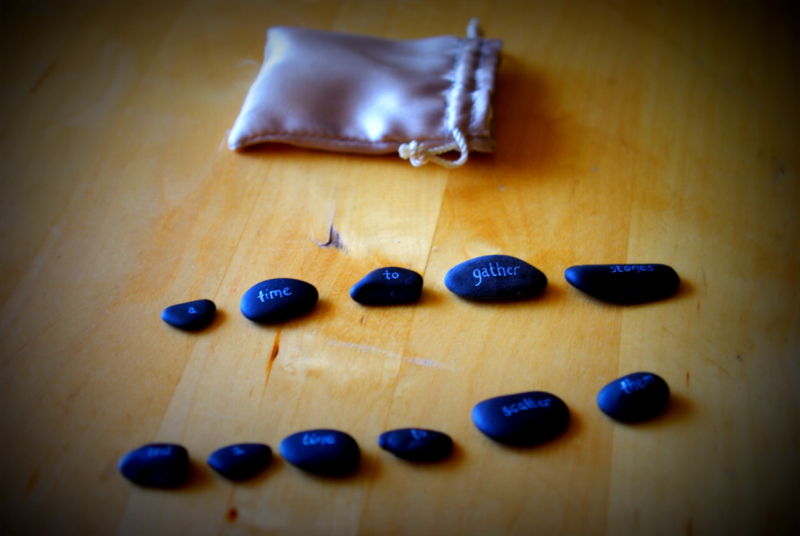
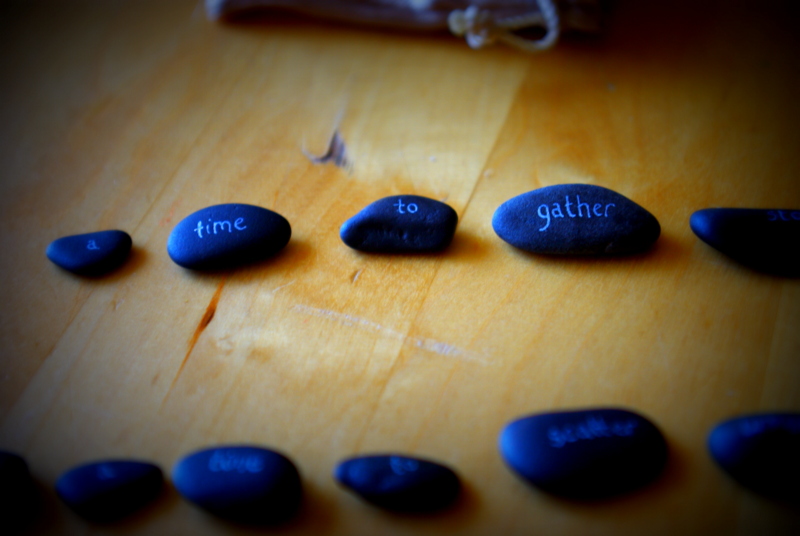
Mine was a little bag full of tiny black stones, each one with a word in tiny writing.
When you put the sentence together, it read
…a time to gather stones and a time to scatter them…
The words of course, are from Ecclesiastes chapter 3. This is a special chapter for me, as I spent a very creative time writing a series of poems based around it, which became part of ‘Listing’.
At present, I am wondering whether I am gathering stones, or scattering them.
In some ways, I am building- all the plans we have for different ways of making a living. In other ways, it feels as if I am taking hold of a handful of stones and throwing them in the air, waiting to see where they all land.
It made me return to those old poems I had written. It is a strange thing to do, as they arise very much in the moment, and so to consider them anew is difficult. The one that impacted me was this one;
A time to gather
There is a time for all things under heaven…
There’s a murmur and mutter of holy unrest
They’re coming
So look to the north, the east and the west
They’re comingFools now wise in the way of the One
Captives unchained, once more on the run
Broken people splinted and cast
Winners now all prepared to be lastSick folk nursed and discharged
Narrow people with lives now enlarged
Bitterness sweetened and ready to serve
Unworthy who get more than they deserveUseless people ready to be used
The inexcusable being excused
The unstable stop up-and-downing
Depressives learn to start clowningSensitive souls softened to others
Orphans find fathers and mothers
The outsiders will sit by the fire
The lazybones now never tireThe tuneless will learn how to sing
The lame will dance Highland fling
The childless will learn how to mother
The selfish will favour the otherThe talentless learn brand new skills
Megalomaniacs surrender their wills
Soldiers lay down the gun
The miserable start to have fun~
Angry folk fit a long fuse
Drinkers will give up the booze
Sinners like me will no longer be
And the faithless will spiritually seeThe becoming of God are flowing together
For now is the time
To gather
When I wrote this, it was a poem of yearning. A few years down the line, despite the battering taken from the ups and downs of community it is still there.
One of the challenges for sensitive damaged souls like me is the tendency towards isolation. I believe that community should be our goal and our aim, in spite of our experience of community.
I was grateful for the gift, and for the little slice of community- thanks Raine!
I have been working on a song today. I used to write songs a lot, but stopped (unsurprisingly) when I no longer sang as much.
It forced me to return to rhyme, which I am usually glad to put aside when I write poetry.
I was thinking about those words of Julian of Norwich– All shall be well, and all manner of things shall be well. The theology behind these simple words is highly complex. Despite living in a time of the the Black Death, which religious people saw as the just punishment of a wrathful God because of the sin of the people, she chose to believe in love and hope. Interestingly, in our times when the theological debate around Atonement is causing such conflict, Julian had some very non standard views about sin and the punishment of God. This from the Wikipedia entry;
Julian believed that sin was necessary in life because it brings one to self-knowledge, which leads to acceptance of the role of God in one’s life. Julian taught that humans sin because they are ignorant or naive, not because they are evil, which was the reason commonly given by the church for sin during the Middle Ages.Julian believed that in order to learn, we must fail. Also, in order to fail, we must sin. The pain caused by sin is an earthly reminder of the pain of the passion of Christ. Therefore, as people suffer as Christ did, they will become closer to Him by their experiences.
Similarly, Julian saw no wrath in God. She believed wrath existed only in humans but that God forgives us for this. She writes, “For I saw no wrath except on man’s side, and He forgives that in us, for wrath is nothing else but a perversity and an opposition to peace and to love”. Julian believed that it was inaccurate to speak of God’s granting forgiveness for sins because forgiving would mean that committing the sin was wrong. Julian preached that sin should be seen as a part of the learning process of life, not malice that needed forgiveness. Julian writes that God sees us as perfect and waits for the day when humans’ souls mature so that evil and sin will no longer hinder one’s life.
Here are the words so far, still listening for their tune;
In the morning when I rise
In the evening when I die
You are thereIn the cloister or the gutter
In the music and the song
In the heart that breaks wide open
In the right and in the wrong
In the tear that no one noticed
In the flow of every stream
In the leaf slowly unfurling
In things seen and yet unseenIn the mist of mellow fruitfulness
Or a stinking torture state
In the stab of empty promises
And twisting with our fate
In the road as yet untraveled
In the barrel of a gun
In the plan that comes unravelled
Or the journey just begunIn the cracks of what we concrete
In the atom and the bomb
In the hope of each spring morning
In a moment too soon gone
In the Bible and the bar room
In famine and the feast
In the spaces we make for him
And where we expect him leastI am learning trust in you
For all manner of things
Shall be well
All manner of things
Shall be well